
TC Electronic DITTO X4 LOOPER
4.1Editor score
Two simultaneous loop tracks
Seven selectable loop effects
MIDI synchronization and decay
Our Multi Track Looper guide compares ten looping stations for track count, audio quality, effects, recording capacity, connectivity, and live performance
A multi track looper gives performers a way to build arrangements in real time, combining phrases, rhythms, vocals, and instruments into evolving songs. The most useful models balance generous recording capacity with immediate control, reliable routing, and effects that remain easy to adjust while playing rather than sending a performer deep into menus.
We compared all ten products by examining their number of simultaneous tracks, audio processing, recording and storage options, effects, inputs, outputs, rhythm features, and performance controls. The guide covers tabletop units, floor-based systems, and pedal-format loopers so musicians can compare capability as well as physical format.
Each pick highlights a different route into multi track looping, from a compact dual-track pedal to elaborate tabletop stations with several phrase tracks. Ratings reflect the supplied customer feedback, while specifications, features, and recommendations are based on the available product information. Prices and availability can change.
4.1Editor score

4.7Editor score

4.4Editor score
This side-by-side overview compares the essential capabilities of the ten featured loop stations, including simultaneous track counts, processing, recording options, connectivity, and performance controls.


The BOSS RC-505mkII is a five-track tabletop looper that combines serious layering capabilities with the kind of control expected from a dedicated performance system. Its customer rating of 4.7 is the highest among the featured products, reflecting a generally favorable reception. It is particularly compelling for performers who want to develop a song from isolated phrases while retaining hands-on control over tracks, effects, and memory.
We may earn a commission when you buy through this link, at no additional cost to you.
Five simultaneous stereo phrase tracks form the core of its appeal. Each track has dedicated controls and an independent volume fader, allowing a guitarist, vocalist, or multi-instrumentalist to build layers without constantly navigating a software-style interface. The 32-bit AD/DA conversion and 32-bit floating-point processing support clean recording and playback, while separate Input FX and Track FX sections can each run four effects simultaneously.
The effects catalog is another major strength. It includes 49 Input FX types and 53 Track FX types, with options covering harmony, electric sounds, and other creative treatments. Customizable FX and Track buttons can be assigned for individual phrase tracks, which helps translate a complex menu structure into a faster performance workflow. Long-throw faders, a new Mark Back function, and 99 memories further improve both control and recall.
Connectivity is extensive for a tabletop unit, with two XLR microphone inputs that support phantom power, two stereo line input pairs, and three stereo line output pairs. The trade-off is size and the learning curve associated with a feature-dense system. Nevertheless, those demands are justified for musicians building full arrangements rather than using a looper only for a short guitar texture. The RC-505mkII is our strongest overall recommendation for serious multi track performance.
This model is best suited to stage performers, looping-focused solo artists, producers building live arrangements, and anyone who needs several tracks with independent effects. A user willing to invest time in learning its routing and memory system gains a remarkably capable center for a pedalboard, studio, or rehearsal setup. It is less appropriate for someone wanting a single-button pedal and only one or two loop layers.
Independent faders and controls for five stereo phrase tracks make it possible to balance layers during a live set. Customizable buttons reduce menu diving, so a rehearsed workflow can remain fast even when the device is surrounded by other equipment.
Separate Input FX and Track FX sections allow the source sound and individual recorded layers to be treated differently. Multiple XLR, line, and output connections support more demanding routing than a basic pedal can offer.
We may earn a commission when you buy through this link, at no additional cost to you.
The BOSS RC-600 is the most expansive floor-based looper in this roundup, offering six simultaneous stereo phrase tracks and nine freely assignable footswitches. Its 4.4 rating reflects a strong level of customer satisfaction, while the feature set positions it as a premium choice for guitarists, singer-songwriters, and multi-instrumentalists who need dependable hands-free operation.
We may earn a commission when you buy through this link, at no additional cost to you.
Six tracks provide more simultaneous layering room than the other featured models. Each phrase can become part of a fuller arrangement, with dedicated effects allowing different layers to receive distinct treatment. The RC-600 also uses 32-bit AD/DA conversion and 32-bit floating-point processing, matching the RC-505mkII in its emphasis on high-resolution audio handling.
Control is a major advantage. Three pedal modes and nine assignable footswitches allow the player to tailor commands to a rehearsal, songwriting, or stage workflow. The device also includes 49 Input FX types and 53 Track FX types, with four effects able to operate at once in each effects section. That combination supports detailed tone shaping without requiring a computer.
The compromises are practical rather than functional. A flagship floor unit needs more room than a compact pedal, and performers must learn the footswitch assignments and editing structure. Some musicians may find the tabletop RC-505mkII easier to navigate visually because of its screen-and-fader presentation. Even so, the RC-600 offers the strongest combination of track count and tactile stage control in this group.
Buy the RC-600 if your main priority is building a substantial arrangement live and operating it with your feet. It is well suited to a dedicated pedalboard, rehearsal room, or performance setup where a broad feature set can be justified. It is less compelling for a beginner seeking the smallest possible unit or a player who needs only a couple of simple loop tracks.
Six simultaneous stereo tracks provide ample room for structured songs, repeated sections, and contrasting layers. The extra track capacity makes this model especially useful when one looper must serve as the centerpiece of a full performance.
Nine freely assignable footswitches and three pedal modes let the player map essential recording and editing functions to the floor. Rehearsing those assignments is essential, but the result can be much faster than navigating menus mid-set.
We may earn a commission when you buy through this link, at no additional cost to you.
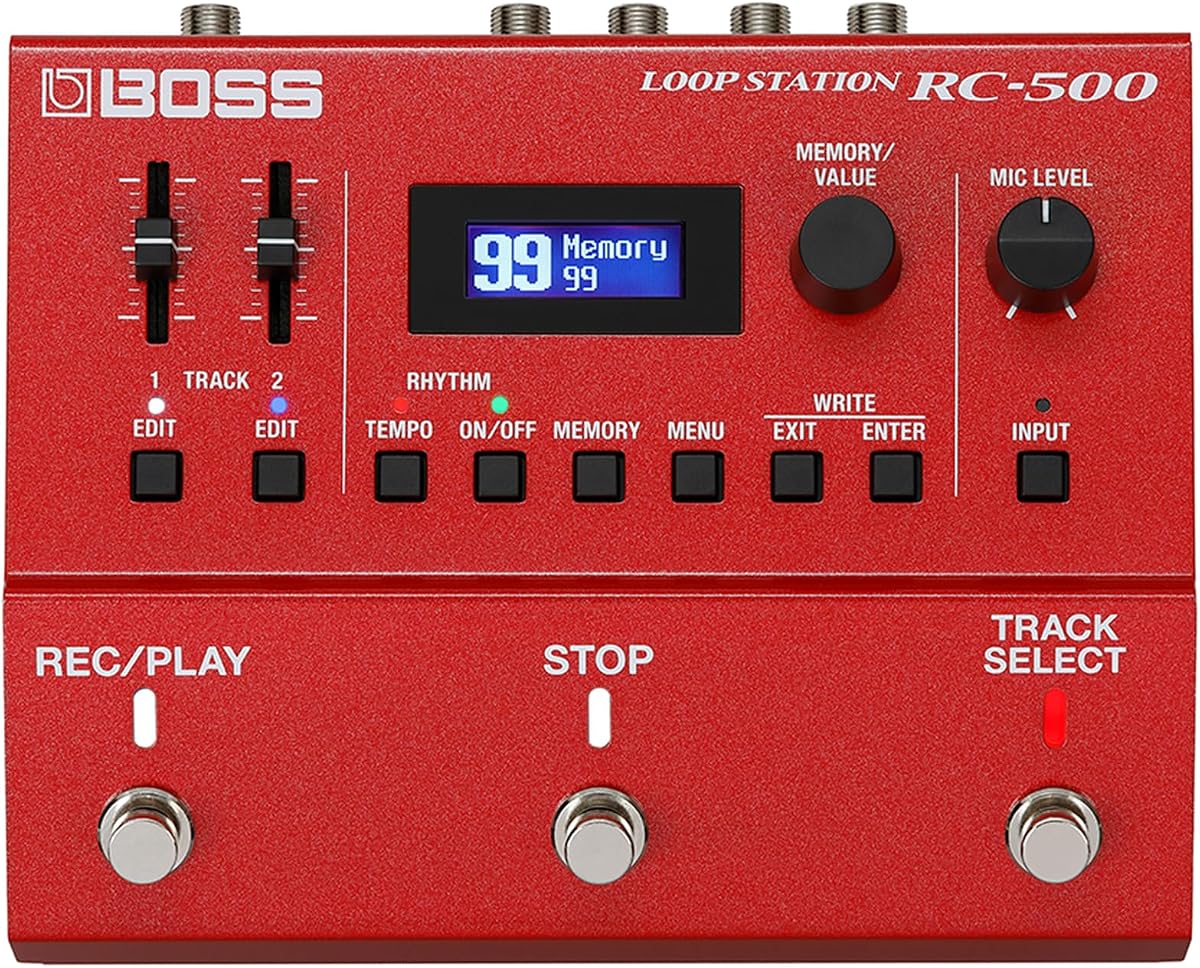
The BOSS RC-500 is a two-track loop station that combines an approachable desktop format with 13 hours of stereo recording time. Its 4.3 customer rating places it solidly within the group, and the balance of phrase storage, rhythm tools, USB file handling, and external control makes it a practical choice for songwriters and performers who want room to experiment.
We may earn a commission when you buy through this link, at no additional cost to you.
The single-track configuration includes two stereo tracks, which is enough for bass-and-chord patterns, a lead with a rhythm part, or basic vocal layering. More advanced arrangements may eventually call for the higher track counts of the RC-505mkII, RC-600, or Aeros, but the RC-500 provides a considerable amount of recording capacity within that structure.
Its rhythm section is a major attraction. The unit includes 16 drum kit types and 57 preset rhythms with A and B variations, giving performers a ready-made foundation without requiring a separate drum machine. A multi-color backlit LCD makes loop status and parameter editing easier to read in dim stages, while the reverse function and loop effects such as repeat, scatter, shift, and vinyl flick add character.
Control and file management broaden its usefulness. Full MIDI I/O uses mini TRS connectors, although a compatible BMIDI-5-35 adaptor is required for conventional MIDI connections. Footswitch, expression pedal, and MIDI control support can extend the workflow, and 99 onboard phrase memories provide plenty of recall locations. USB also allows WAV loops to be backed up and loaded for a DAW workflow.
The RC-500 is a strong recommendation for a musician who wants more than a simple pedal but does not need a six-track stage system. It is particularly attractive for home recording, composition, practice, and moderate live use. The principal limitation is track count: once an arrangement grows beyond two concurrent layers, a more expansive looper may provide a better foundation.
Sixteen drum kit types and 57 preset rhythms give performers an immediate rhythmic structure. A and B variations support changes in feel, helping a solo artist test different arrangements without bringing in another device.
Thirteen hours of stereo recording, 99 phrase memories, and USB file management make captured ideas useful long after they are created. Loops can be retained, recalled, and transferred into a digital audio workflow.
We may earn a commission when you buy through this link, at no additional cost to you.
The BOSS RC-505 Mk2 is a five-track tabletop loop station with a 4.5 customer rating and a hardware layout designed for multi-instrument performance. The supplied listing emphasizes five stereo tracks, two XLR microphone inputs with phantom power, two pairs of stereo line inputs, a rhythm generator, and dedicated looping controls.
We may earn a commission when you buy through this link, at no additional cost to you.
Five tracks are enough to assemble a layered arrangement while keeping the setup relatively compact compared with a full six-track floor system. Independent phrase storage and dedicated controls help separate the roles of repeated instrumental parts, supporting textures, and improvised sections. The tabletop format also leaves more room for visual reference than a small pedal.
Connectivity is a defining feature. Two XLR inputs make it suitable for microphones as well as line-level instruments, and phantom power expands the options for condenser microphone use. The stereo input pairs are valuable for guitarists using stereo pedal chains or multi-instrumentalists combining several sources without immediately resorting to an external interface.
The built-in rhythm generator provides a timebase for performances in which no drummer is present. Together with the looping controls, it gives the device a self-contained practice and songwriting role. The principal limitation in this listing is that its specification summary is much less detailed than the one available for the RC-505mkII, so prospective buyers should confirm exact feature and accessory requirements before purchasing.
This model suits musicians who want the five-track approach of the RC-505mkII in a tabletop presentation and value straightforward loop and rhythm controls. It is also a strong candidate for singers and guitarists who need microphone connectivity. Anyone requiring extensive deep-effect menus, storage details, or custom control assignment should compare the complete specifications with the more fully documented RC-505mkII entry.
Two XLR microphone inputs with phantom power and stereo line pairs provide room for vocals and instruments. This makes the unit practical for a one-person performance that needs more than a single guitar input.
The integrated rhythm generator supplies a foundation for songs and practice sessions. Dedicated looping controls keep the core functions accessible for performers who want to concentrate on the music.
We may earn a commission when you buy through this link, at no additional cost to you.
The Aeros Loop Studio Gold Edition is a six-track stereo looper that combines extensive recording capacity with a touchscreen mixer and broad connectivity. Its 4.2 rating indicates a generally positive reception, while the supplied specifications position it as a sophisticated option for guitarists, vocalists, and multi-instrumentalists who want considerable control.
We may earn a commission when you buy through this link, at no additional cost to you.
Each song can contain six stereo tracks and support unlimited overdubs, giving performers room to layer material without restricting every added part to a new phrase track. Recording can extend to 10 hours per song, and the product supports internal storage plus a 32GB SD card. The card is not included, so users who want the maximum stated storage must supply their own.
Audio handling uses 32-bit floating-point processing, and built-in Reverse, Fade In/Out, and Loop Decay functions provide immediate ways to develop a recorded phrase. A touchscreen mixer is especially valuable in a device with this many tracks because it can present a visual overview of the mix rather than forcing repeated blind adjustments.
Connectivity is extensive, with USB, Wi-Fi, and Bluetooth alongside multiple inputs and outputs. MIDI controller support can aid repeatable performance, while the combination of internal and SD storage makes the unit useful for a standalone set. The Gold Edition also includes a two-year warranty, adding some reassurance for touring use.
The main trade-off is complexity. A feature-rich touchscreen system can take time to configure and learn, particularly for a musician who wants to concentrate on playing rather than production tasks. Nevertheless, the Aeros Loop Studio Gold is a compelling choice for artists who want six tracks, long recording sessions, and flexible wireless connectivity in one multi instrument platform.
Six stereo tracks can each receive unlimited overdubs, supporting both structured arrangements and freer improvisation. The design separates the overall song structure from the freedom to keep developing a particular layer.
USB, Wi-Fi, Bluetooth, and MIDI controller support make the unit adaptable to different working environments. Internal and SD storage add useful options for retaining and organizing complete performances.
We may earn a commission when you buy through this link, at no additional cost to you.
The Singular Sound Aeros Loop Studio uses six song parts and six stereo tracks per song to create one of the more generous multi track structures in this guide. Its 4.2 customer rating suggests a solid reception, and the combination of unlimited overdubs, visual waveform guidance, and flexible routing makes it appealing to performers who want detailed control without relying on a computer.
We may earn a commission when you buy through this link, at no additional cost to you.
The six-part structure is notable because it gives the player more than one dimension on which to organize a performance. Six tracks within each song support layers, while six parts can preserve different sections, ideas, or progressions. Unlimited overdubs on each track further reduce the need to erase and rebuild a phrase whenever a new variation occurs.
Visual design is one of the model's defining qualities. LCD screens and color-coded waveforms help the player identify material and locate the current position, which is particularly useful in a dense six-track workflow. A built-in Mixer View supports control of master volume and individual tracks, providing a visual alternative to making blind changes during a performance.
The Aeros can accept up to three instruments through multiple inputs, outputs, and routing options. Performers can save work to internal storage or use an SD card, which is not included, and export loops for later use in a DAW. A nine-volt power supply is included, along with a two-year manufacturer warranty. The design is also described as intended to withstand rigorous touring.
This model is a strong choice for looping musicians who value clarity, organization, and a large number of tracks in a pedal enclosure. It may be less attractive to someone who wants the smallest possible control surface or a simple one-button workflow. Mastering its visual navigation and routing takes preparation, but that investment can make complex arrangements easier to manage.
Color-coded waveforms and LCD screens reduce uncertainty when several recorded phrases overlap. The Mixer View adds another layer of visual control for balancing the master output and individual tracks.
Multiple inputs, outputs, and routing options allow up to three instruments to be connected. Internal and SD storage help keep the device useful for both live arrangements and later DAW-based work.
We may earn a commission when you buy through this link, at no additional cost to you.
The MOOER GL200 is a looper, drum machine, and rhythm-oriented performance pedal with a 4.0 rating. Its distinguishing feature is DrumMatch AI, which analyzes a played phrase and selects an appropriate groove and tempo. That approach can reduce the effort required to establish a rhythmic foundation, particularly for solo performers who want to start playing quickly.
We may earn a commission when you buy through this link, at no additional cost to you.
The internal library contains 220 drum patterns spread across 11 styles. Users can import up to 20 custom drum kits with as many as 30 samples each, along with 20 MIDI rhythm packs containing up to 50 tracks and 8,000 notes per pack. This makes the GL200 more than a simple accompaniment generator, particularly for musicians who want to shape a distinctive rhythmic identity.
Storage is also unusually deep. There are 100 slots with up to 800 minutes of total stereo recording time, and each slot can retain its own drum groove, BPM, and time signature. That independent configuration is useful when moving between complete arrangements or maintaining a library of songs and practice passages rather than treating every recording as one continuous stream.
The control and connectivity package is broad. Dual TRS MIDI input and output provide clock sync and start/stop functions, while Bluetooth audio can stream backing tracks from a phone or tablet. An XLR and quarter-inch combo input with 48-volt phantom power supports condenser microphones, and a dedicated quarter-inch input allows stereo recording. A 1.28-inch circular touchscreen, dedicated knobs, and three footswitches cover record, overdub, undo, redo, and slot switching.
Automatic recording, count-in, and end-sync functions improve timing, while time stretch and phrase jumping add flexibility for recorded or imported material. The principal trade-off is complexity relative to a traditional two-track pedal, along with the group's lowest customer rating. It is best for rhythm-focused performers who value automatic matching, extensive storage, and connected backing-track workflows.
The system analyzes a phrase and identifies a suitable groove and tempo automatically. This can be useful when a player wants to focus on the musical idea rather than manually auditioning patterns before every recording.
One hundred slots can each hold their own groove, tempo, time signature, and recorded material. The result is closer to a library of prepared arrangements than a short list of interchangeable loop locations.
We may earn a commission when you buy through this link, at no additional cost to you.
The TC Electronic DITTO X4 is a compact dual-track guitar looper that prioritizes a straightforward workflow. Its 4.1 rating reflects a positive reception, and while it does not match the track count of the larger stations, it offers the essential ingredients for a musician who wants to layer guitar phrases without navigating a complex tabletop interface.
We may earn a commission when you buy through this link, at no additional cost to you.
Two loop tracks can develop from simple melodic answers into fuller multi-part compositions. That makes the X4 useful for guitarists who want to build a layered passage, accompany a vocalist, or perform a compact arrangement where a small pedal is easier to manage than a dedicated floor or tabletop system. The format also encourages experimentation because less time is needed to configure the device.
Seven loop effects provide immediate ways to change the character of a captured phrase. Loop decay is another useful function for gradually reducing or fading a repeat, while MIDI sync allows the unit to coordinate more precisely with an external timing source. These features expand the basic record-play-overdub model without requiring a separate drum machine.
True bypass and an analog dry path are important for guitarists concerned about signal flow. When the looper is not actively affecting the sound, the instrument can pass through without the coloration associated with buffering. That makes the X4 easier to incorporate into a pedalboard where clarity and predictable operation matter.
The DITTO X4 is our best budget recommendation for a guitarist seeking genuine multi track capability in a compact package. Its clear limitation is scale: two tracks cannot support the same complexity as five- or six-track systems, and the supplied feature set does not include an onboard rhythm library. It is best for tight arrangements, practice, and adding a second layer to a live guitar part.
The dual-track structure supports a primary phrase and a second answering layer without requiring complex navigation. It is a focused format for performers who want reliable looping with minimal setup.
True bypass and an analog dry path help the looper coexist with a conventional pedalboard. MIDI sync and loop decay add useful control while preserving the direct instrument path.
We may earn a commission when you buy through this link, at no additional cost to you.
The BOSS RC-500 listed here is a dual-track loop station with a 4.5 customer rating and a 13-hour stereo recording capacity. Its combination of onboard rhythms, XLR and quarter-inch inputs, and a color LCD makes it an approachable pedal-format option for performers who want more capability than a basic looper.
We may earn a commission when you buy through this link, at no additional cost to you.
The two-track structure is suitable for building a layered guitar part, combining rhythm and melody, or supporting a vocal performance. Thirteen hours of stereo recording time is generous for rehearsals and live use, giving the player room to capture numerous variations without repeatedly erasing a phrase.
Onboard rhythm tracks provide an immediate pulse for solo practice and songwriting. The XLR and quarter-inch connections widen the range of instruments that can feed the unit, while the color LCD helps show loop status and relevant settings. USB import and export adds value for users who want to move WAV material between the loop station and a computer-based recording setup.
As a compact model, it trades the larger display, physical faders, and deep menu structures found in premium tabletop units for portability. That is a sensible compromise for musicians who primarily need two tracks and a rhythm source. It cannot match the RC-505mkII, RC-600, or Aeros for the number of simultaneous layers, but it delivers the essential tools in a more compact form.
This RC-500 is a strong recommendation for a guitarist or singer who wants long recording capacity, onboard accompaniment, and easy file handling. It is also appropriate for practice, composition, and medium-scale live arrangements. Players building dense multi-instrument arrangements should move up to a five- or six-track model, while players wanting minimal complexity may find the DITTO X4 easier to operate.
The pedal supports two simultaneous tracks for complementary phrases or contrasting layers. This is enough for many guitar and vocal arrangements without taking on the footprint of a large floor unit.
Onboard rhythm tracks provide a foundation, while 13 hours of stereo recording and USB import and export help preserve and reuse ideas. The color LCD keeps important feedback visible.
We may earn a commission when you buy through this link, at no additional cost to you.
The BOSS RC-300 is a dedicated three-track loop pedal offering three simultaneous stereo tracks, dedicated footswitches, and a separate fader for each track. Its 4.5 customer rating indicates a favorable reception, and the one-control-per-track design remains easy to understand for performers who want direct access to every layer.
We may earn a commission when you buy through this link, at no additional cost to you.
Three tracks provide a useful middle ground between a basic dual-track pedal and a larger multi track station. A guitarist can maintain a chord loop, a melodic answer, and a third supporting texture without immediately reaching the complexity of five or six tracks. Dedicated footswitches and controls for each track help the player understand which part is being recorded or altered.
Mixing is direct because every track has its own fader. An expression pedal can control effects in real time, adding another hands-on dimension to a performance. The 99 onboard memories allow users to save and recall loops, and up to three hours of internal recording provide a reasonable amount of space for a focused set or practice library.
The RC-300's limitations are its older storage scale and less extensive specification information compared with newer models. Three hours is less than the RC-500's stated capacity, while the three-track total is below the five- and six-track systems in this roundup. Prospective buyers should also check current input, output, MIDI, and power requirements against their existing setup.
The RC-300 remains a compelling option for a guitarist who values direct track controls and three layers in a pedal design. It is especially suitable for songwriters, educators, and performers building repeatable arrangements. It is less appropriate for someone who needs extensive recording capacity, integrated rhythms, advanced file workflows, or a large library of independent tracks.
Dedicated footswitches, controls, and faders for all three tracks make the device's operation visually understandable. A performer can see and reach the layer being adjusted without navigating a dense menu.
Three simultaneous stereo tracks provide enough room for meaningful arrangements while preserving a pedal-style workflow. Ninety-nine memories and three hours of recording support a library of prepared material.
We may earn a commission when you buy through this link, at no additional cost to you.
The right multi track looper depends on how many layers you need, where it will live in your setup, and how much you want to control while performing. Track count, audio quality, effects, storage, connections, and control style deserve careful attention before making a choice.
Track count is the most visible difference among loop stations. The DITTO X4 and both RC-500 listings provide two simultaneous tracks, the RC-300 offers three, the RC-505mkII and RC-505 Mk2 support five, and the RC-600 and Aeros models support six. A two-track unit is generally sufficient for a lead, rhythm, or bass line, while three to six tracks support fuller arrangements with repeating sections, supporting textures, and multiple instruments.
Choose enough tracks for the arrangements you expect to perform, not merely the highest available number. More tracks can increase editing and organization demands, while too few may require restarting a loop whenever a new layer is needed. Consider both simultaneous tracks and how the product handles overdubs within each track.
Recording time determines how much material can be captured before old ideas must be cleared. The featured products range from three hours of internal recording in the RC-300 to 13 hours of stereo recording in the RC-500 and up to 800 total minutes in the MOOER GL200. The Aeros supports up to 10 hours per song, while the BOSS tabletop models include 99 memory locations for organized recall.
Look beyond total hours and consider phrase count, backup methods, and export support. USB file management, SD card storage, and internal memories make captured ideas easier to preserve. Check whether required storage media is included; the Aeros listings note that an SD card is not supplied.
Several BOSS models use 32-bit AD/DA conversion and 32-bit floating-point processing, while the Aeros Loop Studio Gold also specifies 32-bit floating-point audio. These capabilities are relevant to anyone recording vocals, acoustic instruments, or dense arrangements where clean capture and transparent playback matter. For a simple electric-guitar layer, the more decisive factors may instead be effect quality, noise behavior, and routing.
Treat resolution figures as one part of the audio picture rather than an automatic guarantee of a better performance. A high-resolution device still benefits from correct gain staging, balanced connections where appropriate, and sensible source levels. The unit should also be paired with equipment and cabling capable of preserving the intended signal.
Loop effects can transform a repeated phrase without requiring a separate processor. The BOSS RC-505mkII and RC-600 offer separate Input FX and Track FX sections, with 49 Input FX types, 53 Track FX types, and four simultaneous effects in each section. The DITTO X4 includes seven loop effects, while the Aeros provides Reverse, Fade In/Out, and Loop Decay. The RC-500 adds repeat, scatter, shift, reverse, and vinyl flick treatments.
Separate input and track effects are especially valuable because they allow the source sound and recorded layers to behave differently. Confirm that the effects on your preferred model can be called up quickly. A deeper catalog is useful only if the performance controls let you reach it without interrupting the flow of the song.
The physical format affects how quickly a player can operate the looper. The DITTO X4 and RC-300 use pedals and dedicated switches, the RC-600 provides nine assignable footswitches and three pedal modes, and the Aeros uses a touchscreen mixer. Tabletop BOSS systems combine a display with faders, while the MOOER GL200 uses a circular touchscreen, knobs, and three footswitches.
Choose the interface that matches your experience and stage conditions. Foot controls support hands-free performance, but assignments require rehearsal. Touchscreens provide visual overview, although they can demand more attention. Dedicated faders are intuitive for mixing but occupy more space than a compact pedal.
A multi track looper must connect cleanly to the instruments, microphones, amplifiers, mixers, and recorders in your setup. The RC-505mkII offers two XLR microphone inputs with phantom power, two stereo line input pairs, and three stereo line output pairs. The MOOER GL200 includes an XLR and quarter-inch combo input with 48-volt phantom power, a dedicated stereo input, MIDI, and Bluetooth audio.
Consider whether the device is intended for one instrument or several. Multiple line pairs, flexible output routing, and balanced microphone connections are useful for stage rigs, while USB, SD, Wi-Fi, Bluetooth, and MIDI can streamline a studio or hybrid workflow. Verify the exact connector type and any adaptor requirements before purchase.
An onboard rhythm generator can turn a looper into a self-contained accompaniment source. The RC-500 includes 16 drum kit types and 57 preset rhythms with A and B variations, while the MOOER GL200 offers 220 patterns across 11 styles, DrumMatch AI, custom kit importing, and MIDI rhythm packs. MIDI synchronization also appears in the DITTO X4 and other connected models.
Rhythm features are most useful for solo practice, songwriting, and performances without a drummer. Choose a library with enough variation for your preferred style. Automatic matching or a deep sample editor is valuable for some players, while others may prefer a simple fixed pattern and prefer to control timing from a separate source.
A large floor-based station offers more tracks and footswitch control but requires a dedicated pedalboard area. A tabletop unit can sit near a mixer or keyboard rig and often provides more visual navigation. A compact pedal is easiest to integrate with an existing guitar board but may offer fewer tracks and less elaborate file management.
Account for cable routing, power, room on the board, visibility during a performance, and the likelihood that you will move the unit between rehearsal, recording, and stage. A two-year warranty is listed for the Aeros models, while newer models may provide updated connectivity. Durability should be judged in the context of your own touring and transport conditions.
Begin by placing the looper in a clear signal path and deciding whether it will handle a single instrument, a microphone, or a mixed set of sources. Set input levels conservatively, watch the device's meters, and make the dry signal intelligible before recording. If the unit provides selectable effects banks, assign only the most useful sounds to the controls you can reach during a performance.
Record a short reference loop first and confirm that its start, end, and level are correct. Add a second phrase only after the first is stable, then use individual faders or track controls to balance the layers. Save the finished arrangement to a numbered memory, export it to USB or SD storage when available, and back up important material rather than relying on a single device location.
After each session, disconnect power as directed by the manufacturer and coil cables without creating tight bends around connectors. Keep the unit away from moisture, excessive heat, and direct impact, and clean the enclosure and controls with a dry, soft cloth. Periodically check firmware or companion software updates through the official route, and confirm that custom kits, MIDI files, and loop backups remain readable.
A basic loop pedal usually provides one main loop with a straightforward record, playback, and overdub sequence. A multi track looper can hold several independent tracks at once, often with separate volume controls, effects, memories, and more detailed routing. The expanded format suits full arrangements, while a simple pedal remains convenient for shorter guitar textures and quick musical ideas.
Two tracks are enough for many lead-and-rhythm guitar patterns, while three tracks can support a chord bed, melody, and supporting layer. Five or six tracks are more appropriate when building complete arrangements with recurring sections, multiple instruments, or background textures. The ideal number depends on how much variation you want to preserve without constantly restarting the looper.
A tabletop model generally offers more visible controls, deeper organization, and broader connectivity, making it useful for complex arrangements. A pedal is more compact and can be easier to move through a live signal chain. Choose the format that matches your performance style, available pedalboard space, and willingness to manage deeper controls.
An onboard rhythm generator is useful for solo practice, songwriting, and performances where no drummer supplies the time. Models such as the RC-500 and MOOER GL200 include extensive pattern libraries and variations. If you already control timing from a drum machine, DAW, or backing track, a simpler looper may meet your needs more directly.
Yes, when the model has suitable microphone inputs, phantom power, and gain control. The RC-505mkII and MOOER GL200 both include XLR microphone connections with phantom power, while the MOOER GL200 also provides a dedicated stereo input. Use proper source levels and confirm the output routing before beginning a performance recording.
Check the number of phrase memories, supported recording formats, export options, and whether an SD card is included. USB import and export, internal storage, and SD support can make the difference between a temporary idea and a reusable arrangement. Back up important loops regularly, especially before changing firmware, replacing a card, or resetting the unit.
MIDI can synchronize recording and playback with external timing equipment, while Bluetooth is useful for streaming backing tracks from a phone or tablet. Neither is essential for every musician, but both can improve coordination in a home studio or live setup. Confirm connector formats, supported MIDI messages, and any required adapters before purchasing.
Rehearse every track change, effect selection, and output routing before the performance, including any footswitch assignments. Set conservative input levels, save the final arrangement in a dedicated memory, and carry a backup of important loops. Keep the device and cables secure, and know how to recover if a footswitch is pressed unintentionally.
The BOSS RC-505mkII stands out as the strongest overall option, combining five stereo tracks, detailed effects, extensive memories, and high-resolution processing in a tabletop design. The BOSS RC-600 is the premium choice for performers who want six tracks and assignable footswitch control, while the TC Electronic DITTO X4 delivers the most focused and approachable two-track approach.
Your priorities should guide the final choice. Select a five- or six-track model for developed arrangements, a three-track pedal for direct control, or a two-track unit for compact layering. Also consider recording capacity, microphone and line-level connectivity, onboard rhythm tools, file export, and whether the navigation system fits your attention and stage conditions.
Finally, review the current specifications, accessory requirements, availability, and price before ordering, since all three can change. Confirm connector types, included power supplies, storage media, software compatibility, and warranty details. A multi track looper becomes far more useful when its layout, track count, and controls match the way you actually rehearse and perform.