
hygger 30W Nano Reef Light
4.4Editor score
Five brightness levels
Three color modes
Compact 20-inch coverage
Discover the best Nano Reef LED Lighting options in this expert comparison of brightness, coverage, controls, mounting, cooling, and coral-focused features.
Nano reef aquariums need strong, consistent illumination without taking over a small footprint or creating unnecessary heat. A capable LED light should spread usable light across the tank, offer realistic schedules, support different coral types, and remain simple enough for beginners to operate.
We compared these ten lights by examining published power, coverage, spectrum, control options, mounting flexibility, cooling, and suitability for nano and mixed reef tanks. The list includes app-controlled, Bluetooth, touchscreen, timer-based, and multi-channel designs at different output levels.
Each review explains the strongest benefits, practical limitations, and best audience for that particular light. Ratings reflect the supplied customer feedback, while feature details come from the available product information. Availability and current market listings can change over time.
4.4Editor score
4.4Editor score

4.8Editor score
The comparison below places all ten nano reef lights side by side, emphasizing rated output, coverage, scheduling methods, physical controls, and the kinds of tanks each unit is designed to illuminate.


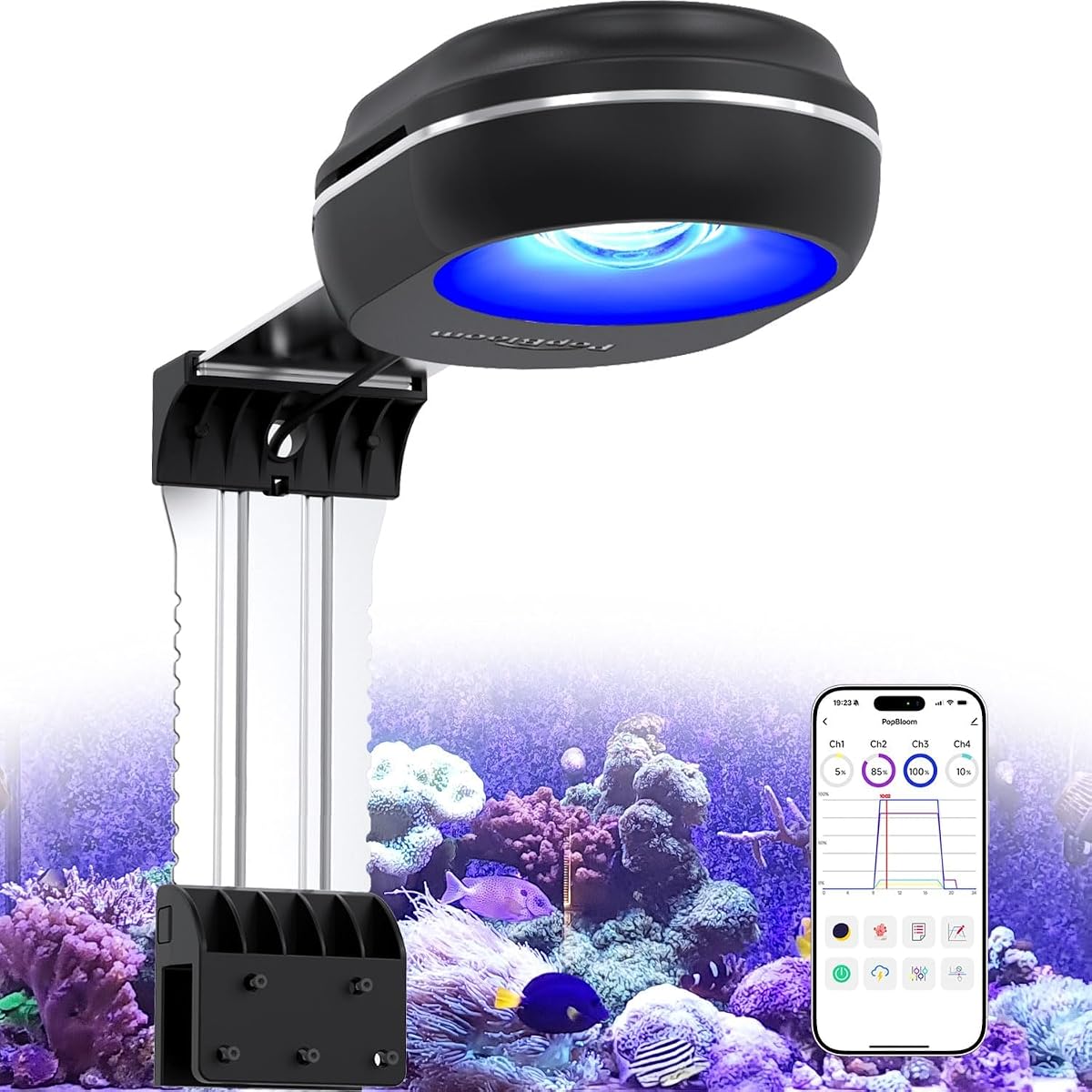
The PopBloom 65W combines one of the strongest documented output specifications in this guide with unusually broad software support. Its supplied rating is 4.4, and the product information highlights PAR above 130 at 20 inches and above 100 at 24 inches. That makes it a serious option for nano SPS, LPS, and mixed-reef tanks that need more intensity than a basic entry-level fixture provides.
We may earn a commission when you buy through this link, at no additional cost to you.
Its most attractive feature is the combination of WiFi control, sixteen dedicated presets, and four independently dimmable channels. The app includes coral-specific programs for SPS, LPS, mixed reefs, fish, acclimation, and deeper-water conditions, along with seasonal, lunar, and lightning simulations. Programmable daily scheduling allows gradual transitions rather than forcing the tank into an abrupt on-and-off cycle.
The physical design is also thoughtfully aimed at small tanks. Rearward sliding mounting arms allow tool-free positioning, while compatibility extends to 20–36-inch-long, 24-inch-wide, and 24-inch-deep tanks. A 110-degree projector-grade glass lens is designed for broad, shadow-free illumination, and active cooling is reported at 32 dB. Dual-light synchronization can produce more uniform coverage across tanks up to 36 inches long.
The trade-offs are the reliance on an app for advanced functions and the potential complexity of sixteen presets and four channels. Some keepers will prefer a physical controller. Even so, the PopBloom offers an unusually complete package for a first serious reef light, and it is our top overall recommendation for readers who want app-guided customization without moving into a much larger fixture.
Beginner presets reduce the need to build a schedule from scratch, while independent channels still provide room for manual refinement. The result is a light that can be configured quickly and adjusted as livestock or coral requirements change.
Documented PAR figures and a 110-degree lens give the unit a useful balance for nano and entry-level reef systems. Dual-light synchronization also makes it more practical for owners expanding into a wider display.
We may earn a commission when you buy through this link, at no additional cost to you.
The hygger 36W is a well-rounded nano reef light for users who want physical controls and a broad selection of LED colors without navigating an app. It carries a 4.4 rating and uses royal blue, blue, white, violet, ultraviolet, and red diodes. That mixture is intended to reproduce the predominantly blue appearance of a reef environment while maintaining useful white and accent colors.
We may earn a commission when you buy through this link, at no additional cost to you.
Its controller offers straightforward scheduling and adjustment. Three timer settings of six, nine, or 12 hours are available, along with five brightness levels from 10% through 100%. Users can cycle through blue, blue-white, and full-spectrum white modes. This is less granular than an eight-channel app-controlled fixture, but it is easy to learn and suitable for establishing a dependable daily routine.
Cooling is handled by upgraded ball-bearing fans, which the product information says can support a service life of approximately 60,000 to 100,000 hours. The aluminum housing and flexible bracket promote heat dissipation and allow installation on different aquarium styles. The wide-angle lens is listed as providing even PAR distribution across 24 by 24 inches, making the fixture suitable for many common 16-to-20-inch nano arrangements.
The main limitation is its simplified control scheme. Only three timer durations are offered, and users select among three mixed color modes rather than independently adjusting every spectral channel. A phone or app is not necessary, however, and the straightforward controller is a meaningful benefit for anyone who values direct physical adjustment. It is a strong choice for soft corals, LPS, fish, and low-to-moderate lighting setups.
Touch controls make daily changes straightforward without a connected device. Separate buttons for timing, brightness, and color reduce the need to memorize a complicated interface.
The ball-bearing fans are described as quieter and longer-lived than traditional oil-bearing alternatives. Combined with an aluminum housing, this supports more consistent operation in a confined display.
We may earn a commission when you buy through this link, at no additional cost to you.
The Hipargero A036 is a compact 36W option for nano tanks that need more than a basic single-output fixture. It has a 4.1 rating and provides two separately dimmable channels, a built-in screen, touch operation, and a 30-minute sunrise effect after power is restored. Those features make it more flexible than a simple timer-and-dimmer light.
We may earn a commission when you buy through this link, at no additional cost to you.
The advertised spectrum includes deep-sea blue, dark blue, sky blue, white, and violet LEDs. A 90-degree three-in-one acrylic lens is intended to improve efficiency and color uniformity, while independent channel adjustment allows the overall light to be softened for fish, LPS, soft coral, or more demanding SPS livestock. The feature set is broad for a unit without app dependence.
Installation is handled by an adjustable painted-metal bracket, and the updated design is listed as suitable for rimless and rimmed aquariums with glass thinner than one inch. Two silent cooling fans are specified below 40 dB(A). The light includes a built-in timer to provide a recurring schedule, but the product information specifically notes that it does not include a programmable timer.
That timer limitation and the relatively modest 4.1 rating are the main reasons it sits below the leaders. Still, the A036 offers a rare combination of dual-channel dimming, a display, touch controls, and a gradual startup in a nano-oriented fixture. It is worth considering for keepers who want more control than a basic timer provides but do not need a smartphone.
Separate dimming provides a more useful degree of control than a single brightness slider. It can simplify adjustments between brighter coral demands and softer requirements for fish or other marine life.
The described 30-minute sunrise ramps brightness gradually after the light is switched on. That soft transition may be more suitable than an abrupt restart for routine power interruptions.
We may earn a commission when you buy through this link, at no additional cost to you.
This 30W reef light is aimed at hobbyists who want automatic daily operation without depending on an app, remote, or complicated controller. It has a supplied rating of 4.0, the lowest among the listed products, but its feature set includes an automatic timer, sunrise and sunset simulation, moonlight mode, and dual-channel dimming.
We may earn a commission when you buy through this link, at no additional cost to you.
The timer offers 6-, 8-, 10-, and 12-hour choices, giving it a little more scheduling flexibility than many competing entry-level nano lights. Natural sunrise, sunset, and moonlight cycles are intended to create smoother transitions, while Cree LEDs in royal blue, blue, white, and violet are specified for SPS, LPS, and soft coral coloration.
Coverage is listed for nano tanks from 10 to 24 inches long and as many as 40 gallons. A 90-degree three-in-one acrylic lens is used to distribute PAR, and two cooling fans are rated below 40 dB. The adjustable anti-rust bracket supports rimmed and rimless aquariums with glass thickness up to 0.9 inch.
The absence of app-based or remote functions is both a limitation and a benefit depending on the keeper. Some users will find the built-in automation sufficient, while others may want finer spectral control. With its straightforward design and natural cycles, this is a practical option for first-time reef keepers who value automation and want to avoid managing another connected device.
The automatic timer handles repetition, while sunrise, sunset, and moonlight modes shape the daily appearance. This keeps routine operation focused on selecting a schedule and making occasional intensity adjustments.
Royal blue, blue, white, and violet Cree LEDs provide a broad foundation for common reef livestock. Independent channels give the keeper some room to tune the balance for a mixed collection.
We may earn a commission when you buy through this link, at no additional cost to you.
The Hipargero A029 focuses on a specific need: a slim reef light for very small aquariums. Its body is listed at only 1.2 inches high, making it a useful choice for compact nano tanks where every visible dimension matters. The 4.1 rating reflects generally positive customer feedback, while the documented tank range extends from 10 to 18 inches.
We may earn a commission when you buy through this link, at no additional cost to you.
The light uses 30W of power and includes royal blue, blue, white, and violet LEDs behind a 90-degree three-in-one acrylic lens. Two dimmable channels can be adjusted from 0% to 100% through touch controls. Sunrise, sunset, and moonlight functions provide a natural daily progression, and the built-in timer supports repeatable operation without a phone.
Its bracket is described as adjustable from 4.7 to 11 inches and designed specifically for nano tanks. The updated version is listed as compatible with rimmed and rimless aquariums, provided tank glass is no more than 0.8 inch thick. Two silent roller fans provide heat transfer, with listed noise below 44.7 dB(A).
Compared with larger fixtures, the A029 has less reach and a somewhat higher published noise figure. Those limitations matter when the tank is crowded or the system sits in a quiet room. Within its intended class, however, the low profile, dual channels, screen-equipped interface, and natural lighting effects make it a convenient choice for compact displays.
A body height of 1.2 inches helps the fixture avoid dominating the view of a small aquarium. It is particularly relevant to nano displays where the equipment should remain visually unobtrusive.
The adjustable short bracket is tailored to compact tanks and thin glass. Its limited range also means buyers should measure the rim and mounting area before ordering.
We may earn a commission when you buy through this link, at no additional cost to you.
The REEFB 72W is the most sophisticated and highest-rated product in this guide, carrying a supplied rating of 4.8. Its major attraction is fine-grained control: eight independently adjustable spectral channels, intensity changes in 1% increments, and real-time spectrum visualization through the koralCore app.
We may earn a commission when you buy through this link, at no additional cost to you.
The product information describes a high-efficiency 70W operating point using 32 high-performance 3W SMD LEDs, while the product name identifies it as a 72W reef light. It also references 34 LEDs across the eight channels. Buyers should understand that the stated power and LED-count descriptions reflect different parts of the published specification rather than assuming a single consistent count.
App-based scheduling can configure sunrise, sunset, intensity, and transitions quickly, with a stated setup time of about 50 seconds. A natural 24-hour cycle can be previewed and refined, while dedicated profiles support SPS, LPS, and mixed reef systems. Multiple REEFB lights can be synchronized through one app, making the platform attractive to owners of more than one aquarium.
Cooling and optics are premium-focused. A hemispherical lens converts a wider 160-to-180-degree spread into a controlled 90-degree beam, while an 1800-square-centimeter ceramic surface and temperature-controlled fan support stable operation at a listed 18 dB. The adjustable bracket and hanging option add installation flexibility. Its complexity is the main drawback, but advanced reef keepers will find the precision impressive.
Eight channels and one-percent adjustments allow much finer tuning than a standard two-channel dimmer. Real-time visualization is particularly useful when comparing settings against coral color and growth response.
The app can synchronize spectrum and schedules across multiple REEFB installations. That feature gives the premium model extra value for collectors who want consistent programs across separate displays.
We may earn a commission when you buy through this link, at no additional cost to you.
The hygger 30W nano light is the most compact option in the guide and a practical starting point for smaller reef systems. Its supplied rating is 4.4, and the round fixture measures just 3.2 inches in diameter. The product information recommends it for aquariums around 18 by 18 inches, including those housing saltwater fish, live rock, and low-light soft corals.
We may earn a commission when you buy through this link, at no additional cost to you.
Its spectrum includes ultraviolet, purple, blue, red, white, and green light, with a 60-degree lens that concentrates the output. Peak PAR is listed at 60 micromoles at a depth of 24 inches, while the diffusion range is 20 by 20 inches. The system uses five brightness levels—10%, 32%, 55%, 77%, and 100%—plus blue, warm-white, and white color modes.
Operation is intentionally uncomplicated. The internal timer provides 6-, 9-, and 12-hour options, and a dedicated switch handles on and off. A flexible anti-rust metal arm allows directional adjustment and is rated for framed or frameless aquariums with glass thickness no greater than one inch. Two roller fans are listed below 44.7 dB(A), with a claimed service life exceeding 50,000 hours.
Its limitations are evident when compared with app-driven models: there is no fine spectrum control, remote access, or multi-light synchronization. The narrower three-color selection can also limit experimentation. For a first nano reef, soft coral collection, or modest mixed system, however, the compact body, broad spectrum, and familiar controls are persuasive. It is our leading budget-oriented recommendation.
The 3.2-inch diameter and flexible arm reduce the visual and physical demands of a nano installation. This makes the light easier to incorporate than a larger square fixture.
A built-in timer, direct switch, and five preset brightness levels cover most routine needs. The design is easier to maintain than a phone-dependent system, particularly in households with several aquarium users.
We may earn a commission when you buy through this link, at no additional cost to you.
The Fluval LED Nano Reef 4.0 is included because its name directly identifies it as a purpose-built nano reef fixture. The supplied rating is 4.1, and its 25W output sits between the smallest and largest lights in this roundup. It is a natural option for aquarists who recognize the Fluval marine ecosystem and prefer a focused product format.
We may earn a commission when you buy through this link, at no additional cost to you.
The available product information is concise, confirming the model name, 25W power, and product identity. It does not provide detailed spectrum composition, coverage dimensions, noise specifications, control methods, or mounting limits. As a result, the strongest evaluation is based on the product's explicit nano focus and established Fluval platform rather than an expansive set of published technical claims.
A 25W output can be appropriate for a compact system with modest lighting requirements. Buyers should still compare the actual fixture dimensions and tank coverage against their aquarium because those measurements are not included in the supplied information. Likewise, anyone interested in Bluetooth, app programming, or multi-channel control should verify the specific features of the 4.0 model before purchase.
This concise information does not make the light a poor choice; it simply means it demands closer verification. For a keeper who already uses Fluval equipment, values a clean compact design, and wants a product expressly designed for nano tanks, the LED Nano Reef 4.0 is worth considering. Those seeking highly detailed specifications may prefer the better-documented alternatives.
The product is explicitly designed around nano reef use rather than being a general aquarium fixture adapted for a small tank. That focused positioning may make layout planning easier for buyers.
The supplied listing does not detail bracket range, coverage, or controls. Confirming those points helps prevent a mismatch between the fixture and the aquarium's dimensions.
We may earn a commission when you buy through this link, at no additional cost to you.
The Fluval SEA Marine Nano combines 20W output with programmable Bluetooth control and a supplied rating of 4.5. Its gradual 24-hour cycle includes sunrise, midday, sunset, and night periods, allowing the aquarium to transition gradually rather than switching abruptly between darkness and full illumination.
We may earn a commission when you buy through this link, at no additional cost to you.
Seven unique spectral bands and independent color control provide better precision than a single blue-and-white selector. Each LED is described as casting 120 degrees of illumination, which supports broad distribution and fewer dead spots. The fixture also has fully adjustable positioning, moving up and down, side to side, and forward and backward, plus an over-the-glass mounting design with a repositionable grip.
Thermal design is another strength. High Thermal Efficiency LEDs are intended to operate at a higher temperature for improved long-term output and spectral performance. A fully encased aluminum shell supports heat transfer while also improving protection from water intrusion and humidity. The frame is listed as 23% lighter and smoother than the preceding generation.
The 20W output is modest beside the 60W and 72W alternatives, and Bluetooth does not provide the multi-aquarium synchronization of a modern app platform. Nevertheless, the programmable spectrum, broad beam, flexible mount, and well-described thermal construction make this a particularly refined choice for small tanks and users who want wireless scheduling without a complex display interface.
The staged sunrise, midday, sunset, and night program makes the aquarium more visually realistic. It also avoids abrupt full-output transitions during a normal daily cycle.
A repositionable grip and multi-axis adjustment help direct illumination toward the coral display. This is useful in shallow tanks where a fixed mounting angle may create uneven coverage.
We may earn a commission when you buy through this link, at no additional cost to you.
The SMATFARM G3 60W is a programmable reef light for keepers who want a physical display and detailed on-device information. It has a 4.2 rating, 60W maximum output, and 26 high-power 5W LEDs. White, blue, and violet-blue channels form the core lighting controls, with 1% dimming intervals and modes for SPS, LPS, and mixed collections.
We may earn a commission when you buy through this link, at no additional cost to you.
Its intelligent control system supports 2.4GHz wireless master-and-slave grouping. One G3 can serve as the master while additional units follow its settings, which is convenient for multi-tank setups. Sunrise, sunset, and moonlight timing can be programmed, and an OLED screen displays menus and parameters. A remote and touch buttons are both included as control methods.
Cooling is provided by a smart fan and a full-coverage aluminum heatsink, with the heatsink area described as 300% larger. Listed noise is below 40 dB, while the light is positioned to deliver strong penetration and broad coverage. Installation can be through an oxidized aluminum bracket for glass between 0.2 and 1 inch or through a hanging arrangement.
Its strengths are detailed programming, readable hardware feedback, and robust grouping. The tradeoff is that users must learn a more involved menu and remote system, and group operation depends on compatible G3 units. It is well suited to owners with multiple aquariums or those who prefer physical feedback over app-based spectrum visualization.
The OLED screen keeps menus and operating parameters close at hand. This is useful for quick checks and can be more convenient than opening a phone app every time the schedule is reviewed.
Master-and-slave operation lets one light control the timing and dimming of compatible units. The result is a more consistent appearance across a collection of similarly sized aquariums.
We may earn a commission when you buy through this link, at no additional cost to you.
The right nano reef light depends on tank dimensions, coral demands, desired automation, and how much control you want to manage. These factors help narrow the field before considering fixtures with similar wattage.
Coverage should be judged by the aquarium's full footprint, mounting height, and glass depth rather than by power alone. The lights in this guide range from fixtures intended for 10–18-inch tanks to models reaching 36 inches in length. PAR can fall considerably as the fixture is raised above the water, so a light advertised for 24-inch coverage may be less effective in a deeper display. Measure from the lamp to the substrate, account for the bracket's position, and ask whether the beam produces even illumination or a concentrated hot spot.
Choose coverage that matches the tank without forcing a small light to illuminate a much larger display. Also consider the fixture's physical size and whether a bracket, grip, or hanging mount can reach the tank rim.
Soft corals and many fish-only aquariums usually place less demand on a fixture than SPS or mixed reef collections. The 20W Fluval SEA and 30W compact models are positioned primarily for smaller or lower-intensity systems, while the PopBloom, G3, and REEFB provide more substantial output. Spectrum controls also matter: blue-dominant fixtures are standard in reef lighting, but white, violet, red, green, and other channels can influence color rendering and the ability to tailor a program.
Match intensity and spectrum to the livestock rather than selecting the highest output automatically. A programmable, multi-channel model offers more room to adjust, while a simpler light may be perfectly adequate for a modest collection.
Reef lighting benefits from gradual transitions, but the available automation varies considerably. Some products use fixed six-, nine-, or 12-hour timers, while others add sunrise, sunset, and moonlight effects. App-controlled models can preview complete daily schedules, and the G3 supports synchronized programs for multiple lights. Built-in timers are useful when simplicity and reduced device dependence are priorities.
Choose the control method that you will actually use consistently. A sophisticated app offers precision, while a physical controller is often faster for routine adjustments and easier for multiple household members to understand.
Dimming is not merely a convenience; it lets a keeper reduce intensity during acclimation, observation periods, or changes to livestock needs. Two-channel controls are common among affordable lights, whereas the REEFB provides eight channels and 1% increments. The G3 also uses fine dimming intervals and provides dedicated SPS, LPS, and mixed modes. Basic lights may offer only a few preset brightness levels and mixed color choices.
More channels provide finer control but also require more setup. Ensure the interface presents the controls clearly and that the light can retain or repeat schedules without unnecessary daily input.
LED reef lights produce heat that must be removed efficiently, especially in a small aquarium with limited air circulation. Published noise figures range from 18 dB for the REEFB to 44.7 dB for the A029, with most others below 40 dB. Aluminum housings, ceramic dissipation surfaces, and quiet fans are common. Fan noise matters most in bedrooms, offices, and other quiet rooms, while heat stability becomes more important during continuous daily operation.
Check the product's mounting clearance and ensure that vents are not obstructed. A quieter specification is beneficial, but consistent cooling and a clear airflow path are more important than chasing the lowest possible decibel number.
Nano tanks vary considerably in rim style, glass thickness, and available bracket space. Several fixtures support both rimmed and rimless aquariums, but their stated glass limits range from 0.8 inch to one inch. The PopBloom uses rearward sliding arms for tool-free positioning, the Fluval SEA uses an over-the-glass grip, and both the REEFB and G3 offer a hanging option in addition to standard mounting.
Measure the rim, pane thickness, and available space before buying. Check whether the bracket can reach, whether the cable can be routed neatly, and whether moving the fixture higher for spread will leave enough clearance above the water.
Connected control can improve precision, but it introduces another interface and sometimes a need for reliable phone or network access. The PopBloom offers sixteen presets and dual-light synchronization, while the REEFB provides eight-channel visualization and management of multiple installations. The G3 uses 2.4GHz master-and-slave grouping and includes a remote plus an OLED display. The Fluval SEA uses Bluetooth, and the simpler hygger and Hipargero designs emphasize local controls.
Owners of one tank may prefer a durable local interface, while multi-aquarium keepers may value synchronization. Choose based on your setup, not simply on whether an app is available.
A wide beam can cover a small footprint efficiently, while a narrower optic concentrates light for deeper penetration. The listed designs range from a 60-degree lens to 110-degree and 120-degree coverage, with the REEFB using a hemispherical lens to form a 90-degree beam. Uniformity is especially important for SPS colonies because intense hotspots can leave shaded areas underlit. Evaluate coverage across the entire tank, especially near the front and side glass.
Look for fixtures with broad distribution, adjustable brackets, and the ability to tune intensity. If one light cannot cover the footprint evenly, two lower-output fixtures may produce a more balanced result than one oversized unit.
Begin by measuring the aquarium, confirming the bracket or grip range, and installing the fixture in a stable position with all vents unobstructed. Set a moderate brightness and acclimate the new schedule gradually. For app-controlled or programmable models, create a schedule that includes gentle sunrise, a stable daytime period, sunset, and a dark night cycle rather than starting with maximum output for the entire photoperiod.
After the first several days, observe coral coloration, polyps, and the overall tank for signs that the light is too strong or too weak. Adjust the daytime intensity in small increments and give the coral time to respond. Keep the lens clean from salt residue, dust, and algae, but switch the fixture off and allow it to cool before cleaning. Use a soft, damp cloth and avoid forcing abrasive material against the lens.
Maintain the cooling system by allowing space around the housing and checking that the fan remains unobstructed. Review the timer, spectrum settings, and mounting position periodically, especially after moving the tank or changing the livestock. If the light is used with multiple units, duplicate the established schedule to the additional fixtures and confirm that their spectra and intensity levels are aligned.
No. A higher-watt fixture is useful only when the light can be mounted close enough to provide the required intensity without creating hotspots. A smaller or lower-power light may be better for a shallow nano tank with soft corals or fish. Match output to tank depth, livestock needs, and usable coverage rather than selecting by wattage alone.
Several models in this guide are designed for tanks around 24 inches long or wider. The 30W full-spectrum fixture lists coverage for 10–24-inch tanks, the hygger 36W is described for 24-by-24-inch coverage, and the PopBloom supports tanks up to 36 inches long. Check the mounting height and beam spread because actual intensity declines with distance.
No. A consistent photoperiod is more important than continuous operation. The listed fixtures offer timer periods ranging from six to 12 hours, with several sunrise, sunset, and moonlight effects. Choose a schedule that provides adequate daily light and keep the tank dark during the remaining period so the aquarium maintains a natural day-and-night rhythm.
Brightness control changes the overall level of illumination, while spectrum control adjusts the balance of individual colors. A light with two dimmable channels gives more flexibility than a single-output fixture, but a model with eight independently controlled channels allows much finer spectral adjustment. The additional control is useful for mixed coral collections, acclimation, and visual refinement.
Not necessarily. App-controlled models are more convenient for detailed scheduling, remote changes, and multi-light synchronization, but they require a compatible device and a greater willingness to manage software. Timer-based lights are often simpler, more direct, and sufficient for a single small tank. Choose based on control complexity, household use, and the number of fixtures you operate.
Raise the fixture only as far as necessary to spread light across the substrate, because additional height reduces intensity but also enlarges the illuminated area. A wide-angle model can cover a small tank more evenly, while two modest fixtures may provide better balance than one unit positioned too low. Adjust the bracket gradually and inspect the tank from several angles.
Several products in the guide are listed as compatible with rimless tanks, but each has glass-thickness limits and bracket requirements. These range from a maximum pane thickness of 0.8 inch to one inch. Confirm the tank measurements, the bracket's reach, and the stability of the rim before installation, especially with heavier fixtures.
Clean the lens whenever salt spray, dust, or mineral deposits become visible. Switch off the light, let it cool, and wipe it gently with a soft damp cloth. Avoid abrasive pads and harsh cleaners that could damage the optical coating. Frequent careful cleaning is especially important in humid systems where salt accumulates quickly.
The PopBloom 65W stands out as the most balanced overall choice because it combines strong documented output, app-guided presets, four dimming channels, flexible mounting, and dual-light synchronization. The REEFB 72W is the premium option for keepers who prioritize eight-channel precision, detailed spectrum visualization, quiet cooling, and multi-aquarium management, while the hygger 30W delivers a compact and approachable package for smaller systems.
The remaining options serve more specific priorities. The hygger 36W offers intuitive physical controls and a broad spectrum, the A036 and A029 suit small tanks with a preference for screens and touch operation, and the 30W full-spectrum fixture prioritizes automatic natural cycles. The Fluval models suit fans of that platform, while the G3 appeals to advanced keepers who want an OLED display and synchronized physical controls.
Before purchasing, measure the tank and glass, confirm the bracket range, compare coverage with mounting height, and identify the coral species that need the most attention. Review current marketplace listings and manufacturer documentation for the latest specifications and availability, as product configurations and support materials can change over time.