
Clear Fast Drying Electronic Contact Cleaner with brush & glove
Fast-evaporating cleaning formula
Residue-free drying
Brush and glove included
Suitable for daily maintenance
Bestelectrical Contact Cleaner guide compares ten listed options for electronics cleaning, ultrasonic lens cleaning, residue removal, lubrication, and ease of
Electrical contact cleaning is more specialized than general dust removal because contacts can collect oil, oxide, soldering residue, and microscopic debris that interferes with conductivity. A useful cleaner should remove contamination quickly, dry without leaving residue, and suit the materials and components being serviced. The supplied list also includes ultrasonic contact-lens cleaners, so compatibility is a crucial distinction.
We compared all ten listed products by examining their intended use, cleaning mechanism, residue behavior, application method, portability, included accessories, timer controls, and available ratings. The guide keeps the ranking order supplied with the data, while clearly separating true electronic contact cleaners from ultrasonic lens-cleaning devices. Where a product listing provides no rating, that limitation is shown rather than filled with an estimate.
Each review explains who the product is best suited to, the benefits supported by its listing, and any practical trade-offs. The top picks are the three products explicitly formulated for electronic contacts: one emphasizing lubrication, one emphasizing fast drying, and one offering a larger 250 ml format. Prices and availability can change, so confirm current details at the linked listing before purchasing.


4.0Editor score
The table compares the ten supplied products side by side, separating electronic contact-cleaning sprays from ultrasonic devices intended for contact lenses and highlighting cleaning mode, portability, accessories, and application approach.




The Pro 3.0 Ultrasonic Contact Lens Cleaner has a 4.2 rating and is built around a 50 kHz German motor. Its defining feature is the combination of ultrasonic cleaning, a lighted makeup mirror, and portable lens storage. It is not an aerosol or pump spray for electrical components, so it should be considered only if the intended application is ultrasonic contact-lens care.
We may earn a commission when you buy through this link, at no additional cost to you.
Three modes cover different routines: three minutes for first aid, five minutes for daily use, and ten minutes for deep cleaning. The listing also describes a 360-degree swirling wash process and three replaceable cases, allowing lenses to be separated and stored. This makes the device more versatile than a simple single-case ultrasonic cleaner, particularly for users who want a compact all-in-one lens-care setup.
The main trade-off is category compatibility. Ultrasonic vibration and lens storage do not clean oxidized electrical contacts, and the machine should not be used as a substitute for a purpose-made electronic cleaner. Its rechargeable design also requires the unit to be charged before first use, and users are instructed to use contact-lens solution rather than water. The illuminated mirror is convenient, though not essential to the ultrasonic cleaning function.
This is a solid choice for contact-lens wearers who value selectable cycles and integrated storage more than a simple cleaning container. It is less appropriate for computer technicians, audio repairers, or electronics hobbyists seeking to restore conductivity. For the stated keyword, buyers should instead look at the dedicated electronic sprays reviewed farther down the list.
The three timer options let users match the cycle to a quick refresh or a longer cleaning routine. Three replaceable cases add separation and make the device function as more than just a cleaning tank.
Rechargeable operation and a compact, multifunctional format make the unit convenient for home, work, and travel. The included illuminated mirror adds utility for lens handling and makeup application.
We may earn a commission when you buy through this link, at no additional cost to you.
This portable ultrasonic contact-lens cleaner carries a 3.8 rating and uses ultrasonic waves above 47 kHz. The listing describes it as a compact kit with a lens remover, mirror, and three soaking boxes. Although it appears among the broader product list, it has no stated function for cleaning switches, relays, connectors, or circuit-board contacts.
We may earn a commission when you buy through this link, at no additional cost to you.
Its most notable feature is the choice of four cleaning durations: 2, 3, 4, or 5 minutes. The device stops automatically when the selected period ends, reducing the need to supervise the cycle. A USB cable is included, and the manufacturer claims that three hours of charging can support nearly 60 days of use, making it potentially convenient for regular travelers or office users.
The compact four-inch design is clearly oriented toward portability, and the included accessories make the package more complete than a bare cleaner. However, ultrasonic lens cleaning is a different task from removing oxide, oil, flux residue, and grime from electrical contacts. Users must still add lens solution, and the listing's suggested cleaning frequency of one to three times per week shows that the machine is a supplemental lens-care device rather than a universal maintenance tool.
The product is best for contact-lens wearers seeking a small rechargeable cleaner with multiple short cycles and a useful accessory bundle. It is not a credible choice for electrical repair because no contact-cleaning formulation, safe delivery method, or material-compatibility information for electronic assemblies is stated. Those needing to service equipment should prioritize one of the dedicated electrical contact cleaners.
The 2-, 3-, 4-, and 5-minute settings provide more control than a single fixed program. Automatic stopping keeps the routine simple once a suitable cycle has been selected.
A mirror, lens remover, three soaking boxes, and a USB cable cover several handling needs. The small format is intended to fit into a handbag, backpack, pocket, or makeup bag.
We may earn a commission when you buy through this link, at no additional cost to you.
The Electrical Cleaner Spray is the first product in the supplied ranking that explicitly combines deep electronic cleaning, lubrication, and conductivity restoration. It has no published rating, but its stated feature set maps directly to the needs of technicians who service switches, faders, potentiometers, relays, and other metal contacts. A precision brush attachment makes application around recessed or difficult-to-reach areas more practical.
We may earn a commission when you buy through this link, at no additional cost to you.
Its lubricating formula is presented as a way to reduce friction in sliding components such as potentiometers, faders, and switches. The listing also says the product forms a thin, protective film intended to shield contacts from environmental damage and reduce static buildup. That makes the spray more versatile than a cleaner that only dissolves deposits: it is presented as both a maintenance treatment and a conductivity aid.
The broad application list includes audio mixers, guitars, cameras, computers, automotive electronics, industrial equipment, connectors, ports, switches, and relays. Even so, users should verify compatibility with coatings, plastics, display components, and other materials before applying it broadly. The listing claims that the formula does not leave residue, but equipment should still be allowed to dry before power is restored, particularly where overspray could migrate beyond the intended contact.
This is the strongest overall match for readers who specifically need an electrical contact cleaner. It combines contaminant removal, lubrication, and a precision application method in one package. Choose it when restoring conductive metal contacts, reducing sticking or jitter in suitable switches, or performing preventive maintenance on audio, automotive, computer, or industrial electronics. It is less relevant to contact-lens users despite the surrounding list including several lens cleaners.
The combination targets two common sources of contact problems: contamination that interrupts conductivity and friction that contributes to sticking or jitter. That dual role gives it broader maintenance value than a basic solvent spray.
The included precision brush helps users direct the cleaner into crevices and around small components. It is particularly relevant for mixers, instrument controls, switches, relays, and precision electronic assemblies.
We may earn a commission when you buy through this link, at no additional cost to you.
The Clear Fast Drying Electronic Contact Cleaner is a purpose-built maintenance spray with no published rating. Its defining benefit is a fast-evaporating formula that dissolves oil and oxide layers, dries quickly, and leaves no residue. The listing says it is gentle on plastic and metal components and does not damage gold-plated plastic parts, making it a practical choice for mixed-material electronic assemblies.
We may earn a commission when you buy through this link, at no additional cost to you.
The application process is straightforward. Users apply a small amount to the included brush, gently work it across the dirty area, and repeat for stubborn deposits. The cleaner should then be allowed to evaporate fully before the device is plugged in or powered. This emphasis on complete drying is important because reconnecting a component while solvent remains could create a different reliability problem.
Its primary limitation is that it is positioned as a cleaner rather than a lubricant. Although the listed benefits include restoring stable conductivity, users who also need to reduce friction in a switch, fader, or potentiometer may find a dedicated lubricating contact cleaner more suitable. The absence of a customer rating also means there is no numerical evidence from the supplied data to support performance claims, although the feature description is specific and coherent.
This is a sensible choice for routine maintenance of contacts that have accumulated oil, dust, oxide, or soldering residue. It is especially useful when quick drying is important and the goal is to clean delicate contacts without leaving a visible film. For technicians, makers, and electronics hobbyists, it offers a focused alternative to general-purpose aerosol cleaners, provided power is disconnected and the surface is allowed to dry.
The rapid-evaporation design supports maintenance tasks where the equipment must be returned to service quickly. Avoiding residue also helps keep cleaned contact surfaces free of an insulating film.
The listing specifically mentions metal, plastic, and gold-plated parts. Users should still test on an inconspicuous area and verify that a specific coating or component is compatible before widespread use.
We may earn a commission when you buy through this link, at no additional cost to you.
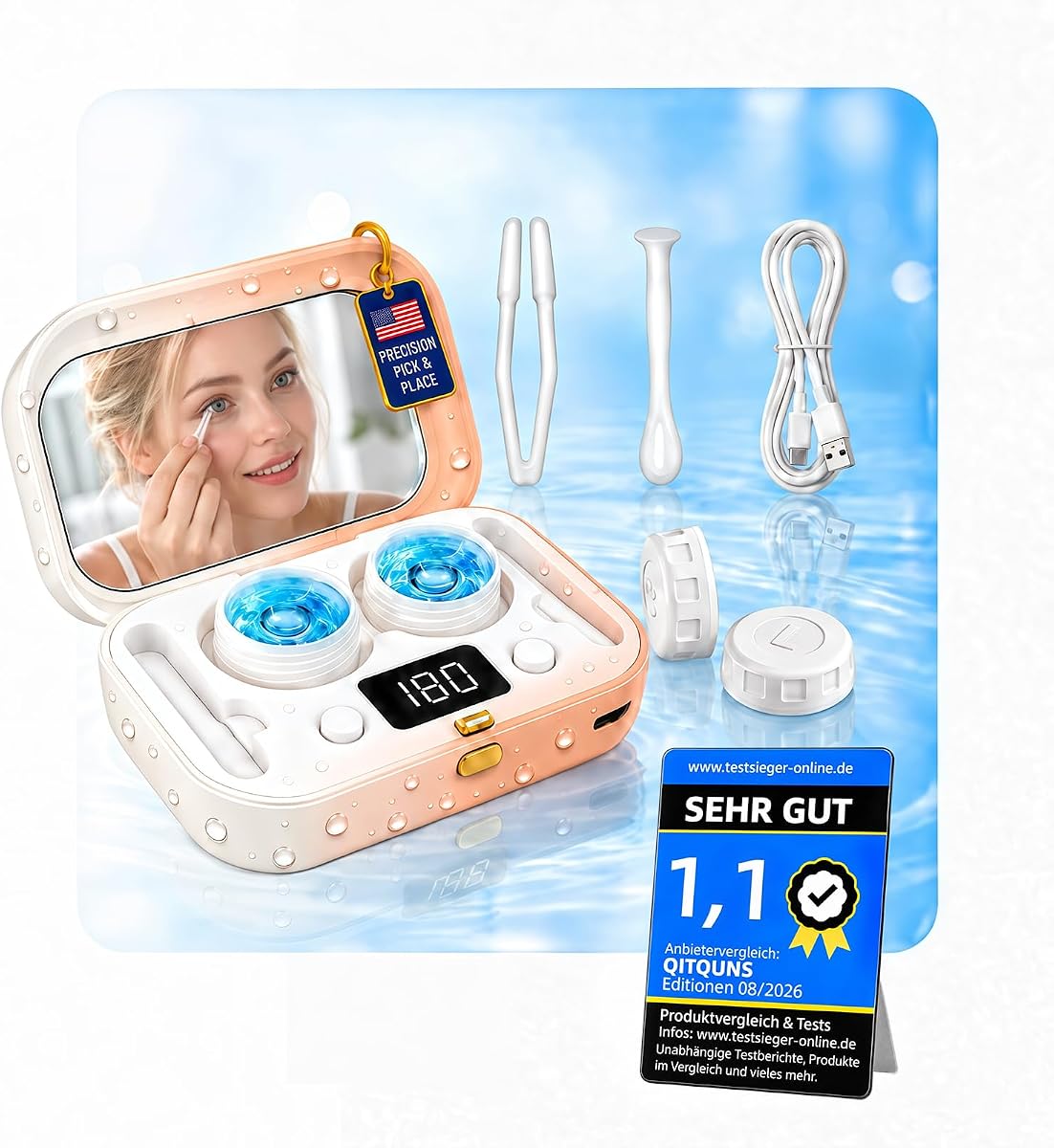
The QITQUNS Ultrasonic 3-in-1 Lens Cleaner has a 4.6 rating, the highest published score in this supplied list. It uses 60,000 Hz ultrasonic operation and is described as removing up to 99 percent of dirt and oil. Its intended market is contact-lens users, particularly people seeking a portable device with more cleaning-cycle options and hands-free applicator tools.
We may earn a commission when you buy through this link, at no additional cost to you.
Four modes provide 120-, 180-, 240-, and 300-second cycles. This range covers quick refreshes through longer routines and is more granular than many competing compact ultrasonic cleaners. The device also combines cleaning, temporary storage, and applicator-assisted handling. Its rechargeable construction and claimed suitability for sensitive eyes, monthly lenses, and protein buildup make it relevant to a specific lens-care audience.
A particularly important limitation is explicitly stated in the supplied data: contact lenses and cleaning solution are not included, and the device does not replace the complete care process required by a lens manufacturer. Users must choose an appropriate lens-care liquid, follow required rinsing and disinfection instructions, and avoid treating ultrasonic cleaning as permission to skip prescribed care steps. It also has no stated role in cleaning electrical contacts.
This is a compelling option within the ultrasonic lens-cleaner category, particularly for users who value its 4.6 rating and four programmable durations. It is not an answer to the stated electrical-contact-cleaning need. Readers maintaining switches, connectors, or circuit boards should use a product specifically formulated for those surfaces and observe all power-disconnection and drying precautions.
The 120- to 300-second range allows users to select a fast refresh or a longer cleaning period. The segmented choices offer greater control than a device limited to one or two fixed programs.
Integrated storage and applicator tools are designed to simplify lens handling. These accessories do not replace disinfection, but they can support a more organized daily lens-care routine.
We may earn a commission when you buy through this link, at no additional cost to you.
This portable ultrasonic contact-lens cleaner has a 3.6 rating and combines a rechargeable cleaning unit with a removable lens-soaking box. The polymer construction is intended to avoid the rust problems associated with some metal cases, and the removable box is presented as a more hygienic and convenient component that can be replaced when needed.
We may earn a commission when you buy through this link, at no additional cost to you.
The operating controls are deliberately simple: a one-button start offers three- or five-minute cleaning periods, followed by automatic shutdown. The lens case can also be used for overnight soaking. The package includes an ultrasonic cleaner, mirror, contact-lens case, plastic applicator, and remover tool, creating a compact all-in-one setup for people who handle lenses frequently.
The design does not address electronic contacts. Its ultrasonic operation is intended to remove tear-protein deposits from lenses, while the removable case and accessories support storage and handling. Users should avoid treating the claim that the case can be soaked in solution as a reason to skip manufacturer-prescribed cleaning or disinfection routines. The device also cannot restore oxidized metal conductivity.
It is most appropriate for travelers, office workers, and contact-lens wearers who value a compact case that can be charged by USB and used with minimal controls. The removable, rust-resistant soaking box is the product's strongest feature. However, the 3.6 rating is the lowest among the rated lens-cleaning products in this list, so buyers should weigh that limited user feedback carefully. It offers little value for the core electrical-contact-cleaning category.
The detachable soaking box allows the ultrasonic unit and storage component to be used as separate pieces. This can make filling, draining, and routine cleaning more manageable.
One-button operation, two cleaning times, and automatic shutdown keep the device approachable. The included applicator, remover, mirror, and case cover common lens-handling needs.
We may earn a commission when you buy through this link, at no additional cost to you.
The 250ML Electronic Contact Cleaner is a dedicated electronics spray with a 4.0 rating and a capacity that distinguishes it from the smaller contact-cleaning options. It is intended for computer motherboards, mobile-phone repairs, industrial control boards, circuit boards, and connectors, giving it the clearest technical focus among the products suitable for the stated keyword.
We may earn a commission when you buy through this link, at no additional cost to you.
Its rapid-evaporation technology is designed to dry within seconds after application, reducing the likelihood of liquid residue building up on sensitive components. The formula is described as removing surface contaminants and restoring optimal conductivity. Application is uncomplicated: apply the cleaner directly to an oily area, wipe repeatedly, and allow the area to dry before further assembly or testing.
The main advantage over smaller sprays is capacity. A 250 ml container can support repeated maintenance sessions, workshop use, or multiple electronic projects without frequent refilling. The trade-off is that no precision brush is identified in the supplied data, so users will need an appropriate wipe, swab, or brush for dense areas. The listing also focuses on cleaning rather than lubrication, and only one numerical rating is available.
This is the top pick for buyers who want a higher-volume contact cleaner for PCB work, computer maintenance, mobile-phone repair, or industrial electronics. It offers the clearest combination of electrical purpose, rapid drying, and generous container size. Users should still disconnect power, avoid spraying sensitive displays or incompatible plastics, and allow the surface to dry fully before reconnecting the equipment.
The 250 ml format reduces the need for frequent replacement during regular maintenance. It is particularly practical for technicians or hobbyists handling multiple circuit boards and connector assemblies.
Rapid evaporation helps minimize lingering liquid around connectors and board surfaces. Direct application followed by thorough wiping keeps the process visible and controlled.
We may earn a commission when you buy through this link, at no additional cost to you.
The 52kHz Ultrasonic Contact Lens Cleaner has a 4.3 rating and combines ultrasonic lens care with a lighted makeup mirror. Its 52 kHz technology is described as gently removing protein deposits and dirt while improving clarity. The product's appeal lies in a clearly organized digital interface and three timed modes rather than in any ability to clean electrical contacts.
We may earn a commission when you buy through this link, at no additional cost to you.
The cleaning durations are 180 seconds for first-aid cleaning, 300 seconds for daily use, and 600 seconds for deep cleaning. A digital display counts down the selected cycle, helping users understand how long the process will continue. The device shuts off automatically when the cycle is complete, and one-touch activation keeps the controls simple for regular use.
Battery life is another prominent feature. The listing states that a one-hour fast charge can support up to 30 days of use, while universal USB charging allows recharging through a convenient cable. The illuminated mirror supports lens handling and makeup application, although its protective film should be removed before first use. These features do not change the product's narrow category: it is made for contact lenses, not switches, relays, or connectors.
The device is best for lens wearers who want a longer deep-clean option, a visible countdown, and an integrated mirror in a portable unit. It is less compelling for a buyer who needs ultrasonic technology at the lowest possible complexity because the added mirror and display increase the multifunctional nature of the product. For electrical-contact maintenance, choose one of the dedicated sprays instead.
The digital countdown and automatic completion make it easy to follow a cleaning routine without repeatedly monitoring the machine. Three durations support both brief and extended sessions.
Rechargeable operation supports portable use, while the lighted mirror assists with lens handling. These features are designed to make daily lens care more convenient.
We may earn a commission when you buy through this link, at no additional cost to you.
The Contact Lens Cleaner Machine has a 4.4 rating and is described as a portable ultrasonic cleaner with a USB charger. That short product description is the only detailed information supplied, so it offers fewer documented features than most of the other lens cleaners. Its higher published rating is noteworthy, but the lack of specifications makes detailed comparison difficult.
We may earn a commission when you buy through this link, at no additional cost to you.
Portability and USB charging are the clearest advantages. The device appears intended for users who want a dedicated ultrasonic lens cleaner that can be recharged through a familiar cable. Its compact format should be relevant to travel and office use, although the listing does not provide dimensions, weight, cycle times, battery capacity, or included accessories.
Because the supplied information does not describe timer settings, cleaning performance, case design, or material compatibility, buyers should review the current product page before purchasing. It also has no stated use for cleaning electrical contacts. Ultrasonic liquid cleaning for lenses should never be assumed to be suitable for circuit boards, switches, displays, or energized components.
This machine is best considered a straightforward ultrasonic option for contact-lens users who prioritize a portable format, USB charging, and a favorable published rating. The lack of detailed specifications is acceptable only if the current listing provides enough information to satisfy the buyer's needs. For the Bestelectrical Contact Cleaner search, it is not relevant and should be excluded in favor of an electronic cleaning formula.
USB charging removes the need for disposable batteries and supports convenient recharging between uses. The portable positioning makes the product more relevant to travel and everyday routines.
The supplied description does not state cycle times, accessories, battery life, or cleaning modes. Checking the current listing is important when the available information is this concise.
We may earn a commission when you buy through this link, at no additional cost to you.
The Four-Timing Portable Lens Cleaner has a 2.6 rating, the lowest published score in the supplied list. It combines ultrasonic operation above 47 kHz with a blue-light disinfection function, four timer modes, and 360-degree high-frequency vibration. Despite its feature-rich description, its low rating warrants a careful review of current customer feedback before purchase.
We may earn a commission when you buy through this link, at no additional cost to you.
The device offers cleaning periods from 120 to 300 seconds and automatically stops when the selected time expires. It is described as suitable for soft, colored, hard, RGP, and OK lenses, with 48,000 vibrations per second and a 240 mAh battery. The claimed battery duration is up to 90 days, based on 90 seconds of use per day after three to four hours of charging.
A significant operational warning is included: users should not rinse the case with water, and the case should be removed before adding liquid. Water or solution entering the electronic machine could cause a malfunction. This illustrates why ultrasonic lens devices should not be treated as generic contact cleaners. They also have no intended function for removing oxide from electrical contacts or improving circuit-board conductivity.
The package includes the cleaning machine, user manual, USB cable, tweezers, remover tool, and solution container, while the type-C port supports convenient recharging. It may appeal to lens users who value several timer settings and blue light, but the 2.6 rating and explicit liquid-entry warning are meaningful drawbacks. For the stated search, the three dedicated electronic sprays are the only category-appropriate selections.
The 120- to 300-second choices provide useful flexibility, and the blue-light function adds a second maintenance approach. Users should evaluate both features against the supplied caution about liquid entering the unit.
Tweezers, a remover, a solution container, a cable, and a manual provide several supporting items. The type-C connection simplifies recharging with compatible modern accessories.
We may earn a commission when you buy through this link, at no additional cost to you.
Choosing an electrical contact cleaner requires matching the formula and delivery method to the contaminated component, the material being cleaned, and the service environment. Because the supplied list mixes electronic sprays with ultrasonic contact-lens machines, establishing the correct product category is the essential first step.
A true electrical contact cleaner is formulated to remove oxide, oil, dust, flux, and soldering residue from conductive surfaces. An ultrasonic contact-lens cleaner is a different device designed to agitate lenses in an appropriate solution, often with storage and lighting features. If the goal is to restore a switch, relay, connector, potentiometer, mixer control, or circuit board, choose one of the three dedicated electronic sprays and disregard the lens-cleaning machines even when their ultrasonic specifications sound impressive.
Residue can create an insulating layer, attract new contamination, or interfere with a repaired connection. Fast-evaporating, residue-free formulas are particularly attractive for equipment that must be returned to service. The Clear Fast Drying cleaner emphasizes rapid evaporation and no residue, while the 250 ml product claims to dry within seconds. The lubricating spray forms a thin protective film by design, so it should be understood as a different treatment rather than judged by the same residue-free standard.
Cleaning and lubrication solve different problems. Deposits interrupt conductivity, while lubrication reduces friction in moving contacts such as switches, faders, and potentiometers. If the symptom is sticking, jitter, or uneven adjustment, the Electronic Cleaner Spray is the relevant choice because its listing explicitly includes a lubricating formula. If the task is limited to removing contamination, a fast-drying non-lubricating cleaner may be more appropriate and easier to use on dense circuit-board areas.
Large exposed connectors can often be treated with a wipe, but recessed switches, relay contacts, potentiometers, and densely populated boards benefit from controlled delivery. The top electronic pick includes a precision brush, allowing the cleaner to be worked into narrow areas without flooding them. The 250 ml option uses direct application and repeated wiping, which is simple but may require the user to supply a suitable swab or brush for detailed work.
Contacts are often mounted inside assemblies that also contain plastics, display lenses, membranes, printed markings, coatings, seals, and optical components. The supplied fast-drying product is described as gentle on metal and plastic and as safe for gold-plated plastic parts, but every material should still be checked. Test a cleaner on a hidden area when the product or component manufacturer provides specific warnings, and never spray directly into fans, speakers, displays, batteries, or sealed openings.
Disconnect power before cleaning an electrical contact whenever possible. Avoid creating a path that could damage a board, and prevent liquid from pooling around powered circuitry. Allow the complete area to dry before restoring power, particularly with fast-drying products where the remaining wait is brief but still necessary. The included glove on one option can help with direct handling, though disposable gloves do not replace power isolation, ventilation, or careful application.
A larger 250 ml container is practical for frequent maintenance, multiple boards, or workshop use because it reduces refill frequency. Smaller bottles may be more convenient to store and carry for occasional repairs. The relevant consideration is not just total volume but the number and size of the assemblies being serviced. For detailed hobby work, a brush-equipped option may be more valuable than added capacity; for broad board cleaning, the larger format may be the better fit.
Published ratings can help compare products with enough customer history, but they do not replace a compatibility check. The two products explicitly intended for electronic contacts have no published rating in the supplied data, while several ultrasonic lens cleaners do. The 250 ml electronic cleaner has a 4.0 rating, and the lens products range from 2.6 to 4.6. Treat those figures as one factor among drying behavior, formula purpose, applicator design, and material compatibility.
Begin by disconnecting the device from power and removing the battery when applicable. Identify the contaminated contact, inspect for corrosion or physical damage, and test the cleaner on a discreet area of the assembly. Do not use a contact lens cleaner on a circuit board, and do not use an electronics solvent on lenses unless the lens manufacturer explicitly permits that exact product.
For the spray-equipped options, apply a small amount to the included precision brush or to a suitable lint-free applicator. Work gently across the contact and surrounding metal, then use a clean wipe to remove loosened residue. Avoid flooding switches, connectors, and densely populated boards. If the listing calls for lubrication, allow the treated contact to settle and dry according to its instructions.
After cleaning, let the area become completely dry before reconnecting power or testing the equipment. Keep the bottle upright, tightly capped, and in a cool, dry place. For ultrasonic lens cleaners, remove the immersion case before adding liquid, use the specified lens-care solution, and follow all required rinsing and disinfection steps.
No. An ultrasonic contact-lens cleaner is designed for lenses and its associated solution, storage case, and handling accessories. It is not formulated to dissolve electrical oxide or restore conductivity in switches, connectors, relays, and circuit boards. Use a cleaner explicitly labeled for electronic contacts and observe the relevant safety instructions.
Contact cleaning removes contaminants such as oil, dust, oxide, flux, and soldering residue that can interfere with conductivity. Contact lubrication adds a thin lubricating film intended to reduce friction in moving components such as switches, faders, and potentiometers. A lubricating cleaner can perform both jobs, but a standard fast-drying cleaner is primarily intended for removal.
A product specifically described as safe for circuit boards may be used according to its instructions, while preventing liquid from pooling and allowing it to dry fully. It should not be sprayed indiscriminately around displays, batteries, speakers, membranes, or sealed components. Test first on an inconspicuous area when compatibility is uncertain.
Wait until the treated surface is completely dry rather than using a fixed short delay. The two fast-drying products are designed to evaporate quickly, but the full manufacturer instructions still take priority. Power should remain disconnected while solvent is visibly present, and extra care is warranted around connectors that sit in a recess.
No. Cleaning can remove contamination that contributes to poor contact, but it cannot repair worn contacts, cracked solder joints, damaged insulation, overheating, or defective components. Regular cleaning is best treated as preventive maintenance and as a way to remove a likely cause of symptoms, not as a substitute for diagnosis or component replacement.
A contact-cleaning formula with a stated lubricating component is generally more relevant than a basic residue remover for a sticky moving control. The Electronic Cleaner Spray is designed for potentiometers, faders, and switches and is intended to reduce friction while cleaning deposits. Confirm material compatibility and allow the treated control to dry before testing.
No. Lens solution is formulated for lenses and approved disinfection procedures, while electronic contact cleaner is formulated for metal, oxides, oils, and electronic components. Mixing the two can damage a lens, leave inappropriate residue on electronics, or compromise required lens-care steps. Use each product only for its stated purpose.
Controlled application is usually better than saturating the area. Use a small amount on the included precision brush or a suitable applicator, then wipe away residue. Protect nearby sensitive components and follow the product instructions, especially when cleaning compact devices where overspray can travel to vents, displays, or optical assemblies.
The strongest category-specific choices are the Electronic Cleaner Spray for its combined cleaning, lubrication, and precision brush; the Clear Fast Drying Electronic Contact Cleaner for rapid, residue-free removal; and the 250ML Electronic Contact Cleaner for high-volume PCB and connector maintenance. These three products directly address electronic contact maintenance, while the remaining ultrasonic products are intended for contact lenses.
Prioritize a formula designed for the exact problem, especially when a symptom suggests friction rather than contamination alone. Verify material compatibility, use a controlled application method, disconnect power, and allow the contact to dry completely. For ultrasonic lens devices, follow the lens-care liquid and disinfection instructions instead of assuming ultrasonic vibration replaces required care.
Ratings, product details, and availability can change, so check the current listing before ordering. Comparing the present product page against the priorities in this guide will help ensure that the selected cleaner matches the component, the work environment, and the level of precision required.