
Cable Matters 10 AWG 30A 3 Prong Dryer Cord
4.8Editor score
Heavy-duty 10 AWG wire
300-volt jacket support
Gripped flat three-prong plug
Strain relief bracket
Our 3 prong dryer cord guide compares ten options for length, wire gauge, amperage, safety listings, plug design, and installation ease.
A 3 prong dryer cord must do more than fit the wall outlet. It needs the correct amperage, wire gauge, connector configuration, and length for your dryer and installation. The right replacement cord also provides dependable strain relief, secure terminals, and insulation suited to a demanding laundry-room environment.
We compared ten cords based on the specifications and construction details provided by each manufacturer. The list covers 4-, 5-, 6-, 10-, and 15-foot options, along with 30-amp dryer cords and one 40-amp range cord. Ratings, safety certifications, conductor sizes, plug styles, and installation features help distinguish each model.
Each review explains who benefits most from a particular cord, while the comparison table offers a quick reference for length and electrical specifications. Installation details and outlet configuration still require careful verification, and prices and availability can change, so confirm the current listing before purchasing.
4.8Editor score

4.8Editor score

4.8Editor score
This side-by-side comparison highlights the differences in cord length, conductor size, electrical rating, safety listing, plug design, and terminal configuration among all ten products.




The POWGRN 6FT 3 Prong Dryer Cord is a compact replacement option for standard 30-amp, three-wire dryer outlets. It carries a 4.6 rating and combines pure copper wiring with an ETL-listed STW jacket. Its six-foot length, right-angle plug, and installation hardware make it especially practical when the dryer sits close to the wall.
We may earn a commission when you buy through this link, at no additional cost to you.
The cord is described as supporting up to 125/250 volts and 3750/7500 watts, which aligns with the kind of high-demand electrical service used by standard electric dryers. The jacket is advertised as resistant to high temperatures, water, flame, and corrosion. Tin-plated copper ring terminals are intended to resist oxidation and support secure conductor connections.
One point worth noting is the 10/3 gauge wording in the product information. That designation can be encountered differently from a cord marketed using 10 AWG conductors, so buyers should compare the actual conductor specifications and terminal fit rather than treating similar-looking labels as identical. The cord also lacks the higher-temperature rating cited by some competing models.
This is a strong choice for a common dryer replacement when six feet provides enough movement, the wall outlet uses the expected three-wire configuration, and the dryer accepts ring-terminal wiring. It combines recognized safety listing with useful strain relief and corrosion-resistant connections, making it a balanced recommendation for careful DIY installers.
The right-angle NEMA 10-30 plug is intended to sit close to a wall outlet without projecting as far into the room as a straight plug. That can improve clearance in narrow laundry closets and reduce strain from accidental contact.
Tin-plated copper ring terminals and an included strain relief bracket give the installer separate points for electrical connection and mechanical support. The bracket is designed to carry the cord's weight rather than allowing repeated pulling to stress the terminal connections.
We may earn a commission when you buy through this link, at no additional cost to you.
The 10FT 3 Prong Dryer Cord, Pure Copper, NEMA 10-30P Plug, ETL Listed combines a 4.8 rating with a generous ten-foot length. It is designed for standard 30-amp, three-wire dryer outlets and is rated for 125/250 volts and up to 7500 watts. That makes it a versatile option for replacements, new dryers sold without cords, and installations involving different dryer brands.
We may earn a commission when you buy through this link, at no additional cost to you.
Its standout features include pure copper wiring, a moisture-resistant STW jacket, a right-angle anti-slip plug, and color-coded wires leading to tinned copper ring terminals. A strain relief bracket is also included to support the connection. These details make the cord more adaptable to different installation preferences while addressing common handling and wear concerns.
The manufacturer lists front-load, top-load, and steam dryers among compatible types, but broad compatibility should never replace checking the dryer's wiring diagram and terminal block. Dryer connections can vary even when the wall outlet has the familiar three-prong shape. The electrical rating also depends on using the cord with an appropriately configured outlet and appliance.
This cord is an excellent choice for buyers who want more reach than a short replacement provides without moving a wall outlet. It is particularly appealing for a dryer positioned farther from the outlet, for a new appliance that lacks a cord, or for anyone who values color coding and a clearly stated ETL listing. Its combination of length, rating, and installation features makes it a leading all-around recommendation.
A ten-foot cord offers enough reach for many dryers positioned away from the outlet, while reducing the need to relocate wiring or rearrange the room. It also allows room for the dryer to be pulled forward for servicing without immediately pulling the cord taut.
Color-coded conductors and tinned copper ring terminals make the wiring process more understandable. The corrosion-resistant terminals are designed for secure connections and easier installation than loose or mismatched connector arrangements.
We may earn a commission when you buy through this link, at no additional cost to you.
The Eastman 6 Feet Electric Dryer Cord, model 61251, is a 30-amp, three-prong appliance cord with a 4.7 rating. It uses three 10-gauge conductors and is rated for 125/250 volts. Although the listing calls it an electric range cord, its three-prong configuration corresponds to the general appliance-cord category represented in this roundup.
We may earn a commission when you buy through this link, at no additional cost to you.
The product information highlights compatibility with most major brands of electric ranges, along with a design intended to resist kinking and damage. It is UL listed, providing a recognizable safety credential. A six-foot length gives enough reach for many wall-adjacent installations without introducing excess cord behind the appliance.
The important caveat is that range and dryer cords can differ in their exact conductor arrangements and terminal formats. Buyers should not assume every 30-amp three-prong range cord will fit every dryer terminal block. The dryer's instructions, the conductor arrangement, the wall outlet, and the connector type must all be checked before ordering.
For someone familiar with this established Eastman appliance-cord design, the model offers a straightforward 30-amp replacement with substantial 10-gauge wiring and a UL listing. It is most suitable when its six-foot length and connector configuration match the dryer and installation. Confirming those details can prevent an otherwise unnecessary return.
Three 10-gauge wires give the cord a substantial conductor profile for a high-power appliance. The specified 30-amp and 125/250-volt rating makes it important to verify that the connected dryer, outlet, and circuit all match these electrical requirements.
The appliance cord is designed to avoid kinking and cord damage during use. That matters in a laundry room where the dryer may be moved occasionally and the connection must remain stable.
We may earn a commission when you buy through this link, at no additional cost to you.
The TOPDC 3 Prong Dryer Cord is a ten-foot, 30-amp replacement with a 4.6 rating. It uses 10 AWG pure copper wiring and a NEMA 10-30P plug intended for older and many newer dryer models. The cord is ETL listed and carries a 125/250-volt electrical rating.
We may earn a commission when you buy through this link, at no additional cost to you.
Reinforced blades are designed to resist accidental bending or breakage, while the ring terminals support a quick and secure connection to the dryer. The SDRT cable is described as capable of withstanding temperatures up to 140 degrees Fahrenheit. These construction details target both electrical performance and routine mechanical wear.
Its 140-degree temperature figure is lower than the 300-volt and 140-degree jacket claims available on certain competing cords, but it is still a stated operating capability for normal dryer environments. As with every model in this roundup, the cord only works properly when connected to compatible 10 AWG dryer terminals and the appropriate three-wire outlet.
This is a sound option for a standard 30-amp dryer that needs a longer replacement cord and when the installer values reinforced plug blades. It is also backed by a stated 30-day return and replacement policy, a one-year limited warranty, and a stated customer-service response time, adding useful support beyond the basic hardware.
The plug's reinforced blades are intended to better withstand accidental impacts and bending. That is useful in busy laundry rooms where the plug may be handled frequently or squeezed into a narrow space.
Ring terminals offer a familiar connection method for attaching each conductor to the dryer's terminal block. Installation should follow the appliance instructions and use the proper connection hardware.
We may earn a commission when you buy through this link, at no additional cost to you.
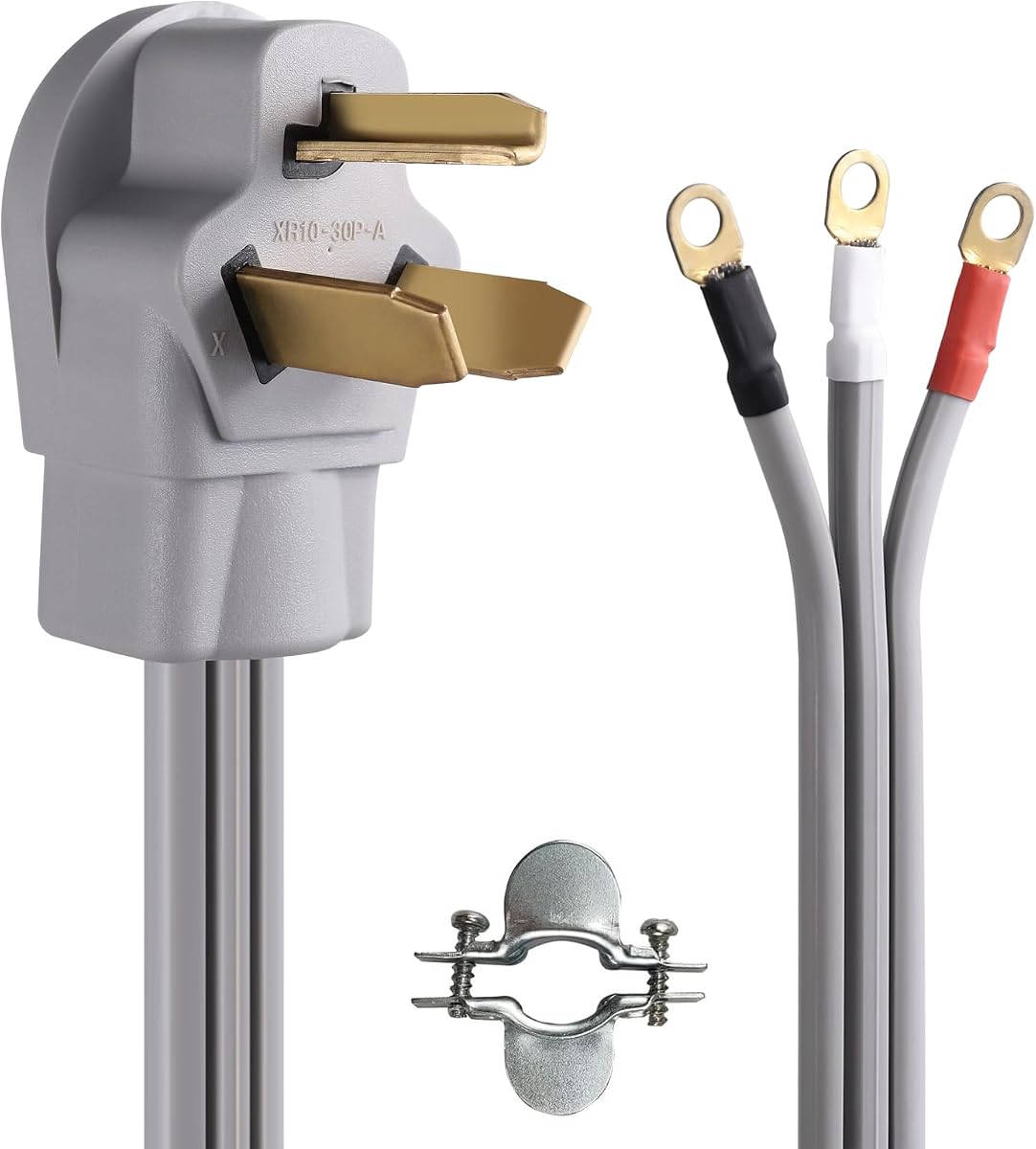
The Cable Matters 10 AWG 30A 3 Prong Dryer Cord combines a 4.8 rating with a detailed heavy-duty design. Its ten-foot, three-wire copper cable is rated for 30 amps, 250 volts, and 7500 watts. It is intended for standard NEMA 10-30R outlets commonly found in older homes and buildings constructed before 1996.
We may earn a commission when you buy through this link, at no additional cost to you.
The SDRT thermoplastic jacket is described as insulating against overheating and wear while supporting up to 300 volts and 140 degrees Fahrenheit. The flat plug includes side grips for easier handling, while ring terminals and a strain relief bracket simplify the dryer-end connection and improve mechanical stability.
Compatibility is broad but still conditional. The product supports older and many newer dryers that use a three-wire connection, including dryers frequently sold without a power cord. It is not intended for four-wire configurations, so the existing terminal block and wall outlet must be inspected before purchase.
This model is an attractive option for replacing a worn cord, relocating a dryer, or supplying a new appliance without a cord. It offers more explicitly documented jacket and electrical details than many general listings, making it easier for careful buyers to compare. Its combination of a 4.8 rating, 10 AWG copper, installation hardware, and ten-foot reach gives it a well-rounded profile.
The listing clearly identifies the NEMA outlet configuration, amperage, voltage, wattage, conductor gauge, and temperature capability. That detail helps buyers check the cord against their dryer and outlet before beginning an installation.
Side grips on the flat plug make insertion and removal more manageable. At the dryer end, ring terminals and a strain relief bracket support both electrical attachment and resistance to pulling forces.
We may earn a commission when you buy through this link, at no additional cost to you.
The 3 Prong Dryer Cord 15 FT is the longest model featured here, offering extra reach for installations where the dryer sits well away from its outlet. It has a 4.7 rating and uses a NEMA 10-30P male plug with three 10 AWG pure copper conductors. Its listed capacity is 30 amps, 250 volts, and 7500 watts.
We may earn a commission when you buy through this link, at no additional cost to you.
The STW thermoplastic sheath is designed for insulation and resistance to overheating and wear. A flat plug supports convenient handling, and eyelet connectors provide a direct termination at the dryer. A strain relief bracket is included to support the cord near the connection point, while the product carries an ETL certification and one-year warranty.
The manufacturer indicates that the overall model family is available in lengths from four to 15 feet and includes round and flat cable styles, although the selected listing is specifically the 15-foot version. Extra length can be valuable in an expansive laundry room, but it should not create a hazardous trip path or interfere with dryer operation.
This cord is best for buyers who have measured a genuine long-distance installation and confirmed a three-wire dryer connection. It offers a useful balance of heavy-duty conductor size, familiar terminal style, and flexible reach. For shorter installations, however, a six- or ten-foot model may be easier to manage and less likely to bunch behind the appliance.
Fifteen feet provides considerable flexibility when the dryer must be positioned away from the wall outlet. It can help avoid moving the outlet or permanently changing the layout, provided the cord remains routed safely.
Eyelet connectors are intended to fit tightly at the dryer's terminal block. Their suitability depends on the terminal hardware used by the appliance, so the existing connections should be checked before installation.
We may earn a commission when you buy through this link, at no additional cost to you.
The 10 AWG 3 Prong Dryer Cord SRDT is a compact four-foot option that carries a 4.8 rating. Its electrical specifications include 30 amps, 125/250 volts, and 7500 watts. The insulated thermoplastic SRDT jacket is described as supporting up to 300 volts and 140 degrees Fahrenheit.
We may earn a commission when you buy through this link, at no additional cost to you.
The cord uses a flat NEMA 10-30P plug and ends in three ring terminals, which makes the dryer-side configuration explicit. Its UL listing adds a recognizable safety credential. The short length is particularly useful when the dryer is installed close to the outlet and excess cable would merely gather behind the cabinet.
Its limitations are primarily practical rather than electrical. Four feet offers less positioning flexibility than the six-, ten-, and fifteen-foot alternatives in the roundup. If the dryer must be pulled forward regularly, allowed away from the wall, or connected farther from the outlet, this length could be insufficient.
Choose this model for a close-in installation that specifically uses a three-wire, 30-amp dryer connection and has compatible ring terminals. It is a strong compact option for replacing a failed cord without introducing extra length. Buyers should verify the distance from outlet to dryer and inspect the terminal block before ordering.
A four-foot cord reduces excess length behind a dryer positioned near its outlet. The compact run can keep the laundry area tidier and leave little slack for accidental pulling.
Three ring terminals provide an explicit connection arrangement for compatible dryers. Their fit, conductor order, and hardware should be confirmed against the appliance instructions before installation.
We may earn a commission when you buy through this link, at no additional cost to you.
The Eastman 3-Prong Electric Range Cord, model 61269, is a six-foot, 40-amp, three-conductor appliance cord rated for 125/250 volts. It receives a 4.7 rating and is UL listed. Unlike most dryer cords in this guide, it uses two 8-gauge wires and one 10-gauge wire, with the middle conductor serving as neutral and the outside conductors serving as hots.
We may earn a commission when you buy through this link, at no additional cost to you.
The cord is designed for electric ranges and is stated to fit the prong configuration used by most major range brands. Its construction is intended to resist kinking and damage, while the mixed 8- and 10-gauge conductors support its higher 40-amp rating.
It should not automatically be treated as a standard dryer replacement. A 30-amp dryer cord may use three equal 10 AWG conductors, while this range cord has a different capacity and conductor arrangement. The appliance wiring diagram, circuit rating, outlet, and physical connector arrangement must all match before such a cord would be appropriate.
This model earns its place in the roundup as an example of why similar-looking three-prong appliance cords are not automatically interchangeable. It is most appropriate for a compatible electric range or another specifically rated appliance installation. Dryer buyers should generally favor a cord explicitly designed and rated for their dryer unless the appliance manufacturer directs otherwise.
The two 8-gauge conductors give this range cord a different electrical profile from the three 10 AWG conductors used by many dryer cords. Matching conductor size to the appliance and circuit is essential for a safe installation.
The middle wire is neutral, while the two outside wires are hot. Identifying the arrangement correctly is essential, and the dryer's or range's instructions should take priority over general assumptions.
We may earn a commission when you buy through this link, at no additional cost to you.
The Eastman 61249 is a compact dryer cord that combines a 4.8 rating with a straightforward 30-amp specification. It measures four feet and includes three bare 10 AWG copper conductors. The flat gray SRDT cable, right-angle NEMA 10-30P plug, flanged spade terminals, and metal strain relief make its construction easy to understand.
We may earn a commission when you buy through this link, at no additional cost to you.
The cord is rated for 30 amps on 125/250-volt AC service, aligning with common three-wire dryer requirements. Its short length suits installations where the dryer sits directly beside the outlet and extra cable is unnecessary. The right-angle plug also helps preserve clearance in tight spaces.
As a three-wire model, it is not intended for dryers that require a four-wire connection. The flanged terminal style must also match the terminal block and hardware found on the dryer. Buyers replacing a cord should compare the old cord's connector format and conductor layout rather than relying only on outlet shape.
This is a compelling budget choice for a close-in dryer replacement where a four-foot length is sufficient. Its high customer rating, 10 AWG conductors, clear electrical rating, and included strain relief make it feel more substantial than a generic short cord. Confirm the terminal style and connection requirements before installation.
The four-foot length works well when the dryer is positioned next to the outlet. Keeping the cable short reduces clutter and makes routine access to the rear connection area easier.
Flanged spade terminals and a metal strain relief component give the installer both a connection method and a way to support the cord. The terminals must be matched to the dryer's terminal block.
We may earn a commission when you buy through this link, at no additional cost to you.
The RVMATE 3 Prong SRDT Dryer Cord is a five-foot option with a 4.8 rating. It uses 10 AWG, three-conductor copper wiring and a NEMA 10-30P plug. Its listed electrical capacity is 30 amps, 250 volts, and 7500 watts, and the product is ETL certified.
We may earn a commission when you buy through this link, at no additional cost to you.
The flame-retardant PVC sheath is designed for durable use, while the SRDT cable is stated to withstand temperatures up to 140 degrees Fahrenheit. A right-angle plug helps the cord sit closer to the wall and reduces the distance between the dryer and outlet. Strain relief is incorporated to protect the terminal connections from cord stress.
The cord is described as compatible with standard three-wire dryer outlets found in many older buildings and homes built before 1996, as well as new dryers purchased without a cord. It is not a universal solution for every dryer, since four-wire models and different terminal arrangements require separate consideration.
A five-foot length offers a useful middle ground between a very short four-foot cord and a ten-foot replacement. It is a good fit for a dryer positioned moderately close to the outlet while preserving some service clearance. The high rating, ETL certification, copper conductors, and strain-relief design make it a strong compact selection.
Five feet is often practical for a dryer installed near but not directly beside the outlet. It permits some movement without creating as much slack as a ten-foot cord.
The strain relief design helps prevent the cord from transferring pulling force to the internal wire connections. Proper installation is still necessary for that protection to function as intended.
We may earn a commission when you buy through this link, at no additional cost to you.
The safest dryer cord is the one that matches the dryer's wiring instructions, the wall outlet, the circuit, the required cable length, and the terminal hardware. Electrical compatibility should be settled before appearance, convenience features, or minor length preferences.
In short, confirm the wiring system before considering length or features.
In short, use the amperage and voltage specified for the dryer and its circuit.
In short, select the conductor size and arrangement required by the appliance.
In short, measure the installation and dryer service space before choosing a length.
In short, favor a listed cord and verify that the configuration matches the appliance.
In short, match both the wall plug and dryer-end connectors exactly.
In short, look for a durable jacket and sound strain-relief design.
In short, replace the cord only when the complete electrical setup is compatible.
Before installation, unplug the dryer at the wall outlet and confirm that the appliance's instructions call for a three-wire cord. Disconnect the old cord from the terminal block only after identifying the conductor positions, and photograph the original connections if possible. Compare each existing wire and terminal with the replacement to confirm a like-for-like fit.
Connect the new conductors to the corresponding terminals according to the dryer's wiring diagram, using the specified terminal hardware and a proper tool. Avoid relying on color alone when the original configuration differs from standard assumptions. Recheck every connection, fit the strain-relief bracket correctly, and ensure that the plug and cord are not pinched or pulled when the dryer is moved.
Restore power only after the terminal connections are secure and the cord is routed safely. Avoid placing the connection in standing water, wrapping excess cord tightly behind the dryer, or using the cord as a handle. Periodically inspect the plug, jacket, and terminal area for discoloration, cracking, heat damage, looseness, or unusual odor, and replace the cord if any of these signs appear.
Most 3 prong dryer cords use a NEMA 10-30R configuration for 30-amp, 250-volt dryer service. The receptacle has the characteristic angled and vertical blade slots. Confirm the outlet markings and the dryer's instructions because not every three-prong appliance connection is interchangeable.
No. A three-wire dryer cord is intended for a three-wire outlet and dryer connection, while a four-wire system includes an additional grounding conductor. The appliance terminal block and receptacle must both match the replacement cord. Using the wrong configuration can create an unsafe or incomplete electrical path.
Choose a length that reaches the outlet without leaving excessive slack and still allows the dryer to be moved forward for servicing. Four or five feet may suit a close-in installation, while six or ten feet covers more common arrangements. Measure the intended path and compare it with the listed cord length before ordering.
10 AWG describes the diameter of each conductor within the cord. It is a common heavy-duty conductor size for 30-amp dryer service. The cord still needs to have the correct overall configuration, including the proper number of conductors, plug, terminals, and electrical rating.
Replacing a compatible cord can be approachable for someone experienced with appliance wiring, but the dryer's instructions and local electrical requirements should be followed carefully. If the outlet, wiring, terminal block, or conductor arrangement is unclear, or there is existing damage, consult a qualified electrician or appliance technician.
A right-angle plug projects sideways from the outlet, which can preserve clearance behind the dryer and reduce pulling on the cord. A flat plug offers a slim profile that can be easier to grip in a confined space. The choice affects handling and clearance, not the electrical match, which must still satisfy the outlet and appliance requirements.
Do not assume that a higher-rated range cord is interchangeable with a dryer cord. Range and dryer cords can differ in conductor size, conductor arrangement, and terminal design. Use the cord specified by the appliance manufacturer and confirm that the circuit, outlet, terminal block, and connector arrangement all match.
Look for a cracked or melted plug, discoloration, burnt odor, heat damage, exposed conductors, a loose connection, or a jacket that no longer protects the wires. Stop using the cord if any of these signs are present. Also investigate unusual breaker trips or repeated interruptions rather than assuming the cord is the only issue.
The POWGRN 6FT cord offers a balanced combination of pure copper wiring, ETL listing, right-angle clearance, and installation hardware. The ten-foot pure copper model earns the strongest overall recommendation because its 4.8 rating, flexible reach, color-coded conductors, and detailed safety specifications cover many replacement situations, while the Eastman 61249 stands out as the budget-focused four-foot option.
Prioritize exact electrical and connector compatibility before focusing on length. Confirm the three-wire configuration, 30-amp service, conductor size, plug type, terminal style, and the dryer's installation instructions. Within those constraints, choose the shortest cord that supports normal positioning and servicing, while paying attention to safety listing, jacket construction, and strain relief.
Current prices and availability can change, so review the latest product listing and all specifications before buying. The information in this guide is designed to simplify product comparison, but the appliance manual and the condition of the existing outlet, wiring, and terminal block should remain the final authority for a safe installation.