
ROVE R2-4K Dual PRO
4.3Editor score
Dual STARVIS 2 sensors
4K front, 2K rear
CPL filter included
Explore the best Dual Dash CAM under 300 options, comparing front and rear video quality, night performance, parking features, GPS, Wi-Fi, storage, and ease of
A dual dash camera records more than the road ahead, often adding a rear view or an interior-facing perspective that can help explain an incident from multiple angles. The best Dual Dash CAM under 300 options balance sharp video, dependable low-light recording, useful parking protection, and straightforward installation. Resolution alone does not determine quality, so sensor performance, HDR, lenses, and storage support matter just as much.
This guide compares ten dual-camera systems using their stated recording resolutions, viewing angles, sensors, night-vision features, connectivity, GPS capabilities, parking modes, and included accessories. It covers front-and-rear setups as well as front-and-cabin models that may appeal to rideshare, taxi, delivery, and family-vehicle owners. Every pick records more than one perspective, but they differ in sensor sophistication, app support, parking flexibility, and installation requirements.
The recommendations show why the leading choices stand out and where more affordable alternatives make sense. The number-two option stands out for simultaneous true 4K front and rear recording, while other picks emphasize premium STARVIS 2 sensors, cabin monitoring, touch controls, or discreet installation. Product specifications, availability, and current prices can change, so readers should verify the latest listing details before purchasing.
4.3Editor score
4.9Editor score

4.4Editor score
The comparison below places each dual-camera system on the same practical criteria, including channel resolution, low-light technology, wireless transfers, positioning, and parking monitoring. It highlights genuine differences in sensor quality, recording behavior, and installation rather than treating every multi-camera setup as equivalent.


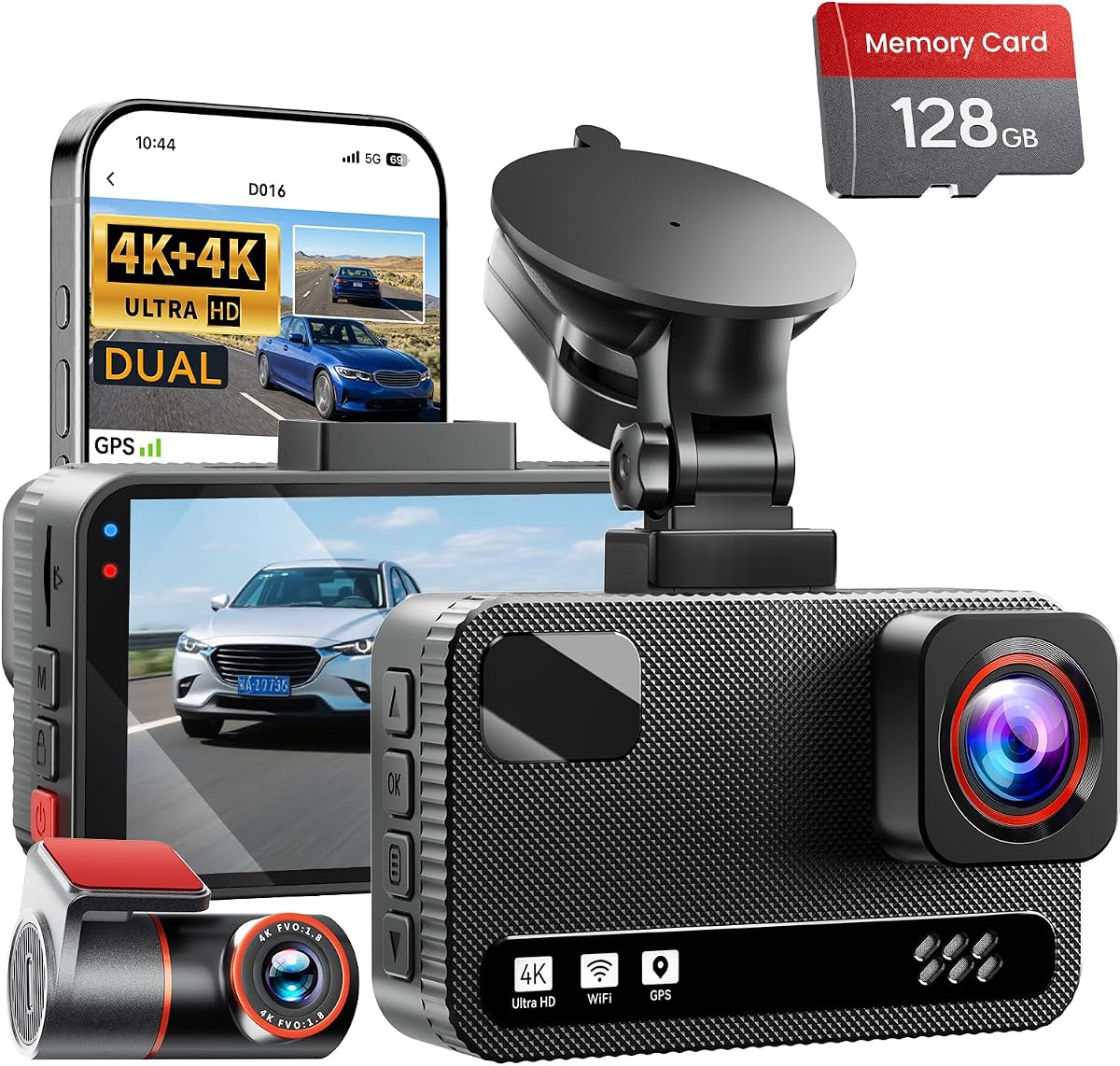
The 4K+4K Dual Dash Cam is the strongest all-around recommendation in this guide because it records true 3840-by-2160 video from both the front and rear at the same time. That distinction matters: buyers do not have to accept a lower-resolution rear channel simply to obtain a premium-looking headline specification. The front lens covers 170 degrees, while the rear lens covers 150 degrees, giving both ends of the vehicle broad scene coverage.
We may earn a commission when you buy through this link, at no additional cost to you.
Low-light performance is a major strength. The f/1.5 aperture, five-element optical lens, and WDR are designed to balance difficult lighting conditions, particularly when headlights, streetlights, tunnels, or changing exposure create bright and dark areas in the same frame. Dual-band 5GHz and 2.4GHz Wi-Fi also makes the product more practical for everyday use because the app supports previewing, downloading, playback, GPS data review, and settings management from compatible phones.
The feature list includes photo capture, voice guidance, emergency locking, loop recording, a collision sensor, and GPS positioning. Parking surveillance offers time-lapse operation and event-based clips that are stored in a protected folder, although a separate hardwire kit is required. Buyers seeking a hidden hardwired installation may also need to route and conceal the supplied cables carefully rather than relying only on a simple power connection.
This is the best choice for drivers who want high resolution from both perspectives, fast wireless access, and useful parking monitoring without moving up to a premium dual-sensor platform. The 18-month coverage and 24/7 support add reassurance, but the true 4K rear channel and broad lenses are the decisive advantages. It is particularly well suited to road disputes, rear-end incidents, and drivers who prefer fewer compromises between front and rear footage.
Recording 4K from both cameras gives the rear view genuine detail rather than serving as a supplementary Full HD channel. That can improve the usefulness of footage when vehicles, signs, or other small subjects appear behind the car.
The dual-band connection supports convenient viewing and transfer through the phone app. It is particularly useful when a driver wants to preserve or share a clip without repeatedly removing the memory card.
We may earn a commission when you buy through this link, at no additional cost to you.
The ROVE R2-4K Dual PRO is the premium choice for drivers who prioritize sensor quality, flexible phone transfers, and reduced windshield glare. Its front camera records 3840-by-2160 video at 30 frames per second, while the rear records 2560-by-1440 at the same frame rate. The front and rear use different Sony STARVIS 2 sensors, combining the 8-megapixel IMX678 with the 5-megapixel IMX675.
We may earn a commission when you buy through this link, at no additional cost to you.
The f/1.7 front aperture, f/1.55 rear aperture, and HDR imaging are central to the product's low-light proposition. The wide 150-degree front and 140-degree rear views preserve broad road coverage, while the rear's 2K resolution retains more detail than a typical 1080p channel. Dual-band Wi-Fi 6 is specified for transfers of up to 30MB per second, and the app supports recording management, downloads, settings, and over-the-air firmware updates.
This model also includes a 128GB ROVE PRO microSD card and a circular polarizer filter. The card is tested and optimized for 4K recording, while the filter can reduce reflections from the windshield. Storage support extends to 1TB, giving owners considerable flexibility. Quad-mode GPS supports GPS, BEIDOU, GALILEO, and GLONASS, and the bundled player can display routes, location, and speed during playback.
The trade-off is that parking mode requires a separately sold hardwire kit, and the rear camera does not match the front's 4K resolution. Even so, the combination of dual STARVIS 2 sensors, strong apertures, Wi-Fi 6, GPS, included storage, and a CPL filter makes this one of the most thoughtfully equipped systems in the roundup. It is ideal for drivers who regularly travel at night, use an expansive windshield, and want premium image components and accessories in one package.
The paired STARVIS 2 sensors are designed for higher light sensitivity, reduced noise, and less motion blur. Wide apertures complement those sensors, helping both channels preserve useful detail during darkness, tunnels, rain, and sudden exposure changes.
Wi-Fi 6 and the ROVE app create a convenient path from recording to phone review. Built-in quad-mode GPS adds route and speed context without requiring a separate positioning accessory.
We may earn a commission when you buy through this link, at no additional cost to you.
The COOAU D30S is a distinctive front-and-inside alternative to the rear-facing systems in this guide. Its front camera can record 4K at 25 frames per second with a 170-degree field of view, while the second camera combines a 2.5K image with a 1080p channel and a 150-degree view. This arrangement is particularly relevant to Uber, Lyft, taxi, delivery, and other passenger-carrying drivers.
We may earn a commission when you buy through this link, at no additional cost to you.
The cabin camera is equipped with four infrared LEDs and an f/1.8 aperture, allowing black-and-white recording in complete darkness. The front camera also uses an f/1.8 aperture and Sony STARVIS 2 chip for improved low-light performance. The app provides wireless preview, downloads, and sharing, while built-in GPS records route, location, and speed. A supercapacitor supports reliable operation across cold and hot conditions, including the listed range of -4°F to 158°F.
Parking functionality includes collision detection, motion detection, and time-lapse recording, although a hardwire kit must be obtained separately. The G-sensor can lock event footage during driving, while loop recording helps maintain continuous coverage. Cards up to 256GB are supported, but no card is included, so owners should confirm their storage needs before installation.
The D30S is the most compelling option here when documenting the passenger compartment matters as much as recording traffic. It is not a conventional front-and-rear setup, and its infrared cabin output is monochrome, but that limitation is intentional for nighttime visibility. For rideshare professionals, families concerned about interior monitoring, or drivers who want both road evidence and cabin context, it offers one of the most useful dual-camera configurations available.
The four infrared LEDs illuminate the cabin without relying on visible light, helping the camera preserve detail after dark. This is valuable when an incident occurs in an unlit area or when passengers need to be documented clearly.
Recording the road and cabin simultaneously provides a more complete account than a road-only camera. It can reveal what happened inside the vehicle as well as surrounding traffic and road conditions.
We may earn a commission when you buy through this link, at no additional cost to you.
The VIOFO A229 Plus is built around image quality rather than headline 4K resolution. Both channels use Sony STARVIS 2 IMX675 sensors, and the front and rear record at 1440p. The front can capture up to 60 frames per second, giving drivers a useful option for fast-moving traffic, while dual-channel HDR helps balance bright and dark areas in challenging scenes.
We may earn a commission when you buy through this link, at no additional cost to you.
The sensors are described as delivering two and a half times the dynamic range and light sensitivity of earlier STARVIS generations, with lower noise and less motion blur. Voice control provides twelve commands, including taking a photo, locking video, toggling Wi-Fi, and switching the displayed camera. This reduces the need to handle the compact camera while driving and allows a driver to check either channel directly.
Connectivity and positioning are thoroughly handled. A 5GHz Wi-Fi module supports app-based preview, downloads, photos, and settings. Quad-mode GPS supports GPS, BEIDOU, GALILEO, and GLONASS, adding location, speed, and time information to video playback. Three parking modes provide buffered event detection, time-lapse, and low-bitrate continuous recording, but the HK4 hardwire cable is sold separately.
The main compromise is that no microSD card is included, and the front's 1440p at 60fps setting is unavailable while HDR is active. Even so, dual STARVIS 2 sensors, well-rounded controls, GPS, and sophisticated parking options make the A229 Plus a strong pick for drivers who want mature, balanced hardware. It is especially attractive to owners who prioritize sensor consistency and nighttime reliability over maximum pixel count.
A 60fps front option can make moving vehicles and road details easier to inspect frame by frame. The rear still captures 1440p, and HDR can be enabled on both channels when balanced exposure matters more than the highest front frame rate.
Twelve voice commands make common actions possible without touching the unit. The system also provides audible notifications for setting changes and memory-card errors, which is useful during installation and daily operation.
We may earn a commission when you buy through this link, at no additional cost to you.
The REDTIGER F7N TOUCH combines a 4K front camera with a 1080p rear camera, giving buyers high-resolution forward coverage and a practical secondary view. The front uses a Sony STARVIS 2 sensor, a 170-degree wide-angle lens, WDR, and HDR, while the rear records at 1080p through a 140-degree lens. Together, the two channels cover a broad portion of the vehicle's surroundings.
We may earn a commission when you buy through this link, at no additional cost to you.
The defining feature is its touchscreen, which can lock emergency footage, enable Wi-Fi, and capture still images directly. Physical buttons and voice commands remain available, giving users several ways to operate the unit. Android and iOS users can connect through the REDTIGER Cam app, preview recordings, download clips, and share them. The stated 5GHz transfer speed of up to 20MB per second is well suited to moving 4K files.
Built-in GPS records location, speed, and route information. Loop recording overwrites older material as necessary, while the G-sensor locks clips associated with impacts or sudden movement. The supplied 128GB card makes the package ready for initial use, and a suction mount, wiring tool, rear camera, and related installation accessories support a straightforward setup.
Parking mode includes collision or sudden-motion detection and time-lapse surveillance, but it requires a separate hardwire kit. The rear's 1080p resolution also trails several dual-4K or 2K alternatives. Nevertheless, the touchscreen, flexible controls, front STARVIS 2 sensor, GPS, and included storage make this a user-friendly option for drivers who want easy interaction with a conventional front-and-rear layout.
The touchscreen makes common actions visible and straightforward, while the retained buttons and voice commands provide useful alternatives. This combination is helpful for new owners who want an interface that does not require navigating the app for every adjustment.
A 4K front channel, STARVIS 2 sensor, and wide 170-degree lens support detailed forward recordings. WDR and HDR improve the handling of contrast, which is particularly useful during bright daylight and tunnel transitions.
We may earn a commission when you buy through this link, at no additional cost to you.
The ROVE R2-4K Dual offers an unusually complete standard package for drivers who want front-and-rear coverage, wireless management, GPS, parking options, and included storage. The front camera records 2.5K and upscales to 4K for playback, while the rear records at 1080p. Buyers should note that the 4K front output is upscaled rather than native 4K.
We may earn a commission when you buy through this link, at no additional cost to you.
Image quality is supported by a Sony STARVIS 2 IMX675 sensor, an f/1.5 front aperture, an f/1.8 rear aperture, and HDR. These features target clearer nighttime footage, road signs, license plates, and surrounding vehicles. The 3-inch IPS screen displays speed and compass information, and built-in GPS stores routes, locations, and speed stamps for later review through the free desktop player.
Dual-band 5GHz and 2.4GHz Wi-Fi supports phone-based viewing and downloads of up to 20MB per second. The ROVE app can also manage settings and receive over-the-air firmware updates. Parking mode offers time-lapse, motion detection, and collision detection, with triggered footage stored in a locked event folder. A hardwire kit is required for this function and is not included.
The box includes a ROVE PRO 128GB microSD card, dual USB car charger, power and data cables, rear-camera cable, mounts, clips, trim tool, and cleaning wipe. Support extends to cards up to 1TB, while the built-in supercapacitor and thermal protection support long-term reliability. This is a well-rounded choice for drivers who value app convenience and a generous accessory bundle more than native 4K on the front channel.
Dual-band Wi-Fi, firmware updates, and downloadable clips make the camera easier to manage without constantly removing its card. The built-in display still provides a useful local view of speed and compass direction.
Time-lapse, motion detection, and collision detection give owners different ways to monitor a parked vehicle. Event clips are locked for preservation, while the voice alert informs the driver after the next startup.
We may earn a commission when you buy through this link, at no additional cost to you.
The Affver 4K+2.5K stands out as the value-focused recommendation because it combines a 4K front camera, a 2.5K rear camera, Wi-Fi 6, built-in GPS, and a 64GB memory card. The front records through a 160-degree wide-angle view, while the rear uses a 155-degree lens. These specifications place it well above basic front-and-rear systems that rely on Full HD footage in both channels.
We may earn a commission when you buy through this link, at no additional cost to you.
The upgraded wireless system supports transfers of up to 10MB per second over 5GHz Wi-Fi 6, which speeds up phone review compared with older Wi-Fi arrangements. A dedicated app provides access to recordings, settings, GPS information, and route playback, while desktop players are available for Windows and Mac users. The 3.59-inch IPS display offers a readable local interface, and the low-profile housing helps preserve windshield visibility.
Low-light performance is supported by an f/1.5 aperture, a six-layer lens, and WDR. The listed design is intended to improve light intake and balance dark areas during nighttime driving. Seamless loop recording keeps storage manageable, while a three-axis G-sensor automatically protects footage associated with a collision. The lighter dual-port car charger also includes a USB output for charging another device while the camera remains powered.
The main limitations are the 64GB capacity of the included card and the less detailed sensor information compared with premium STARVIS 2 models. Parking mode and the full feature set should be checked against the latest listing because firmware and package details may evolve. Even so, this camera offers an unusually balanced specification sheet for value-focused buyers who want 4K forward video, a sharper-than-1080p rear view, fast wireless transfers, and GPS in one package.
A 2.5K rear channel retains noticeably more detail than a standard 1080p rear camera. Combined with a 4K front and broad viewing angles, it provides useful coverage in both directions without moving into premium pricing.
Wi-Fi 6 and the app make it easier to move clips to a phone without removing the card. The included pass-through USB output also helps preserve a charging point for the driver or passengers.
We may earn a commission when you buy through this link, at no additional cost to you.
The 4K+2K Dual Dash Cam is a strong pick for drivers who want a compact, screenless design that blends into the area around the rearview mirror. It records true 3840-by-2160 video from the front and 2560-by-1440 from the rear. The front uses the 8-megapixel Sony STARVIS 2 IMX678 sensor, an f/1.8 aperture, and HDR to support low-light clarity.
We may earn a commission when you buy through this link, at no additional cost to you.
A major practical advantage is the absence of a built-in screen. The streamlined design can reduce visual distraction, lower power consumption, and support cooler operation. Mounting hardware includes a 3M adhesive mount and an electrostatic sticker intended to provide stability and residue-free removal. Storage capacity extends to 512GB, but a suitable high-speed UHS-1 U3 card is not included.
The dual-band 2.4GHz and 5GHz Wi-Fi connects through the Coxpal app for viewing, downloading, and sharing without a computer. Built-in GPS records route, speed, and location as a watermark or through a PC and Mac player. Parking monitoring supports continuous 1080p recording or a one-frame-per-second time-lapse mode, although a hardwire kit is required.
Loop recording automatically replaces older files, while the G-sensor protects emergency footage and a manual button allows drivers to preserve selected clips. This model is a compelling choice when discretion, power efficiency, and native 4K forward recording matter more than having a visible screen. Drivers should confirm the latest app compatibility and mounting position before installation, especially if they want the cameras hidden as much as possible.
Removing the display creates a smaller visual and electrical footprint. That can help with windshield aesthetics, reduce distractions, and support longer operation in a closed vehicle.
True 4K recording is supported by the IMX678 STARVIS 2 sensor. Combined with HDR and a wide aperture, it is well suited to capturing fine details in daylight, dusk, rain, glare, and low-light conditions.
We may earn a commission when you buy through this link, at no additional cost to you.
The COOAU Dual 2.5K is a compact front-and-inside camera designed for rideshare and taxi use. Its road-facing camera records at 2560 by 1440 and 30 frames per second through a 170-degree lens, while the cabin camera records at 1080p through a 150-degree lens. That combination provides both traffic context and an interior perspective without requiring a larger multi-camera unit.
We may earn a commission when you buy through this link, at no additional cost to you.
The interior camera has four infrared lights and an f/1.8 aperture for black-and-white low-light recording. The infrared mode can be disabled when visible-light color footage is preferred. On the road side, an f/1.8 six-glass lens and WDR balance bright and dark areas. A small 1.5-inch display provides basic information without taking up a large portion of the windshield or dashboard.
Built-in Wi-Fi connects to the COOAUDash app for viewing, recording, downloading, and sharing. The app works with Android and iOS, although connecting the phone to the camera prevents simultaneous use of Android Auto or CarPlay. GPS records speed, route, and location, and the vehicle can display speed in kilometers per hour or miles per hour.
Parking monitoring uses an adjustable G-sensor to detect vibration or collision while the vehicle is off. A hardwire kit is required but sold separately, and no memory card is included. The camera supports Class 10 or higher cards up to 256GB, while the supercapacitor is specified for operation from -4°F to 158°F. It is a practical cabin-recording option for professional drivers seeking useful features at a lower entry point.
The front-and-inside arrangement can help document interactions with passengers as well as surrounding traffic. It is particularly relevant for rideshare, taxi, delivery, and family use where the interior context may matter.
The compact 1.5-inch display and small camera housing preserve outward visibility. Infrared illumination gives the interior camera a dependable night-recording option when cabin lights are off.
We may earn a commission when you buy through this link, at no additional cost to you.
The VIOFO A129 Plus Duo remains a practical front-and-rear option for drivers who value smooth forward footage, straightforward app control, and multiple parking workflows. The front camera records 1440p at up to 60 frames per second, while the rear records 1080p at 30 frames per second. Both channels are active at the same time and use a 140-degree viewing angle.
We may earn a commission when you buy through this link, at no additional cost to you.
STARVIS sensors support the system's night capabilities, while HDR automatically adjusts bright and dark regions. This helps when oncoming headlights, illuminated signs, and dark roadside areas appear together. Built-in Wi-Fi provides app-based preview, downloads, and settings changes, and the GPS logger records speed and location while synchronizing the time through satellites.
Three parking approaches are supported: automatic event detection, time-lapse at selectable low frame rates, and low-bitrate continuous recording. The optional hardwire kit is needed for parking operation. An optional Bluetooth remote allows a driver to save or lock a video without touching the camera, which helps reduce distraction.
The G-sensor, motion detection, automatic start and stop, loop recording, built-in microphone and speaker, mobile app, and support for cards up to 256GB round out the feature set. A card and hardwire kit are not included. While newer models offer higher rear resolutions, dual-channel HDR, or more modern sensors, the A129 Plus Duo remains appealing for drivers who prioritize a high-frame-rate front channel and established dual-camera functionality.
A 60fps 1440p front channel can make fast-moving traffic easier to analyze frame by frame. It also gives drivers an option when a conventional 30fps recording feels less fluid.
Event detection, time-lapse, and low-bitrate modes suit different parking priorities. Drivers can choose event-only capture to reduce file volume or continuous low-bitrate recording for broader surveillance.
We may earn a commission when you buy through this link, at no additional cost to you.
Choosing a dual dash camera means balancing the quality of two channels, the situations in which you need footage, and the complexity of installation. Resolution, sensor performance, storage, connectivity, parking support, and field of view should be evaluated together rather than independently.
Resolution determines how much fine detail is retained, but it is only one part of image quality. True 4K front footage can make signs and plates more useful, while a 2K rear channel may provide a better balance than 4K front and 1080p rear if storage and transfer speed are concerns. Pay particular attention to whether a listed 4K mode is native or upscaled. The ROVE R2-4K Dual, for example, records the front at 2.5K and upscales it for playback.
Night footage depends heavily on the image sensor, aperture, HDR, and lens design. Sony STARVIS 2 sensors appear across several recommendations because they are designed to improve light sensitivity, reduce noise, and limit motion blur. Wide apertures such as f/1.5 can also gather more light, but HDR and white-balance behavior remain important in tunnels and scenes containing sharp brightness changes. The highest-resolution channel is not automatically the clearest one after dark.
A dual system may pair a road-facing camera with a rear-facing camera, as most products do, or with an interior-facing camera. Front-and-rear coverage is best for traffic disputes and parking incidents. Front-and-inside coverage is especially useful for rideshare, taxi, delivery, and family drivers because it records passenger activity as well as the road. The COOAU D30S and the smaller COOAU Dual 2.5K are the principal cabin-focused options here.
Wide lenses help capture vehicles entering from the side, road signs, and cross traffic, but they can introduce edge distortion and make objects appear smaller. Most choices in this guide use broad viewing angles between 140 and 170 degrees. Drivers should consider how the camera is mounted, whether the windshield curves, and whether they want extra peripheral coverage or a more natural-looking image. A wider rear angle can be especially valuable for parking and reversing situations.
Continuous dual-channel recording consumes more storage than a single-camera setup. Check the supported card capacity, required card speed, and whether a card is included. Products accept anywhere from 256GB to 1TB cards, while the ROVE R2-4K Dual PRO and several 4K-oriented systems need reliable high-endurance storage. Loop recording keeps the system running, but emergency locking and dedicated event folders help preserve important files from being overwritten.
Wi-Fi makes previewing and downloading recordings far easier than removing a card and transferring it to a computer. Dual-band 2.4GHz and 5GHz systems are generally better suited to large 4K files, while Wi-Fi 6 can improve transfer performance when the phone and camera support it. Buyers should also review the app's compatibility, export options, and whether connecting the phone to the camera interrupts features such as Android Auto or CarPlay.
Parking mode is not automatically included with every bundle. Event detection records after a collision or movement is detected, time-lapse creates continuous condensed footage, and low-bitrate mode saves storage while monitoring longer periods. A hardwire kit is usually required to power these functions after the vehicle is switched off. Kits may also be needed for a cleaner installation, so check whether the correct cable is bundled before ordering.
Built-in GPS adds route, speed, location, and time context to recordings, which can make a clip more useful when the sequence of events matters. Voice commands, touchscreens, physical buttons, and local displays offer different control methods. Screenless models are often more discreet and may consume less power, while a display can make setup and status checks more convenient. Choose the interface that reduces distraction and fits the vehicle's windshield layout.
Begin by choosing a memory card that matches the camera's stated capacity and recording requirements, particularly when using 4K channels. Format it in the dash camera if the manufacturer recommends that step, then mount the front unit securely behind or beside the rearview mirror. Keep the lens inside the windshield's defroster area if possible, and verify that the rear cable can reach the second camera without crossing obstructions.
Route power cables along the A-pillar, headliner, and trim rather than across the dashboard. If using parking mode, install a compatible hardwire kit and confirm the vehicle's electrical connection is safe for the intended parking duration. After installation, check both camera angles, live speed display, GPS acquisition, Wi-Fi connection, emergency locking, and loop recording before relying on the system for evidence.
Review recordings regularly, keep important files backed up outside the overwritten loop, and clean the lens gently with a soft cloth. Inspect mounts, cables, and the card for looseness or damage, particularly during temperature changes. Use only the specified power source and compatible storage, and avoid leaving loose accessories inside the vehicle where they could become hazards.
A dual camera provides evidence from two directions at the same time, reducing uncertainty about what happened behind the vehicle or inside the cabin. It is especially useful for rear-end collisions, parking incidents, and rideshare documentation. The extra channel also requires more storage, more wiring, and potentially more power, so installation planning matters.
Most of the featured systems require a separately sold hardwire kit to record parking events after the vehicle is switched off. A regular accessory power connection may stop when the car is locked or enter a low-power state. Confirm that the kit is compatible with the exact model and follow the manufacturer's installation instructions.
No. Resolution is only one factor in image quality. Sensor size, low-light sensitivity, aperture, HDR, lens design, exposure, and compression all influence the result. A lower-resolution channel with a strong sensor may look better at night than a higher-resolution channel with weaker low-light performance.
Front-and-rear systems are generally better for documenting traffic, parking, and potential rear-end incidents. Front-and-inside systems are more useful for recording passenger activity, which makes them popular with rideshare, taxi, and delivery drivers. Some owners keep both types, but one dual system with the correct perspective is usually easier to manage.
Yes. Core recording, loop recording, and G-sensor protection normally continue without a phone connection. Wi-Fi mainly simplifies live preview, downloading, sharing, settings changes, and GPS playback, although a removable card can still be transferred to a computer for conventional file management.
Storage needs vary with frame rate, compression, bitrate, and recording duration, but two high-resolution channels fill a card faster than one. Buyers should use a high-endurance card within the camera's supported capacity and periodically back up important clips. Loop recording and event locking help retain key files while older footage is replaced.
A hardwired parking mode can draw power while the vehicle is off, so the hardwire kit's cutoff and voltage settings are important. Time-lapse or low-bitrate modes usually reduce consumption compared with continuous high-resolution capture. Drivers should use a kit approved for the model and avoid testing parking operation for long periods without confirming the vehicle's starting battery remains healthy.
Keep both lenses clean, check the adhesive mounts and cables periodically, and confirm that recordings continue after the card becomes full. High temperatures can affect cards and adhesives, so avoid leaving an unformatted spare card in a hot vehicle. Regular spot checks help reveal loose mounts, corrupted cards, or accidental changes to recording settings.
The 4K+4K Dual Dash Cam is the strongest general recommendation because it provides native 4K from both perspectives, wide lenses, capable low-light hardware, dual-band Wi-Fi, and GPS. The ROVE R2-4K Dual PRO is the premium alternative for drivers who prioritize dual STARVIS 2 sensors, Wi-Fi 6, a CPL filter, and included high-endurance storage. The Affver 4K+2.5K delivers the most compelling value-oriented combination of resolution, wireless transfer, GPS, and included card.
The right choice depends on use case as much as specifications. Traditional front-and-rear users should consider image quality, field of view, and parking requirements. Rideshare and taxi drivers may prefer the COOAU cabin-focused models, while VIOFO buyers may value established sensors, 60fps forward recording, and mature parking options. Screenless owners may appreciate the discrete 4K+2K model, while touch-focused users may find REDTIGER more intuitive.
Before purchasing, verify the exact channel resolutions, memory-card requirements, included accessories, app compatibility, and hardwire-kit needs. Current prices, firmware, availability, and promotional offers can change, so compare the latest listing information and read recent customer feedback. The right dash camera is the one that records the perspectives you need, remains easy to operate, and stores trustworthy evidence without creating installation or maintenance headaches.