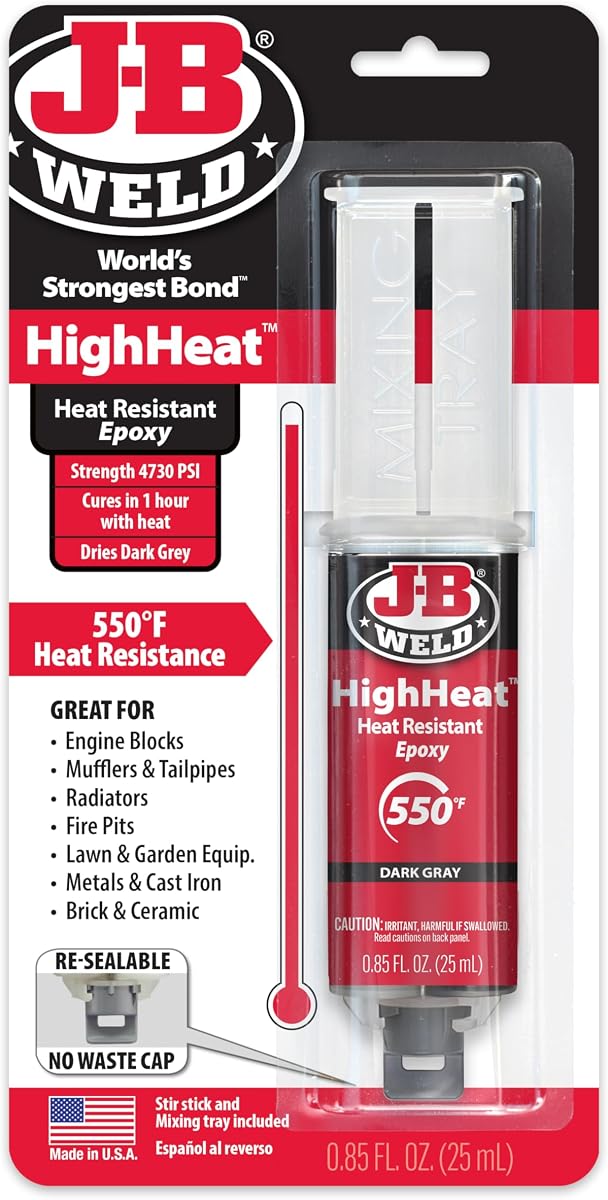
J-B Weld High Heat Epoxy Syringe
4.6Editor score
Permanent two-part epoxy bond
Heat resistance up to 550°F
Chemical and fuel resistant
Discover the best heat resistant adhesive for ovens, grills, engines, and fireplaces, with ten products compared by heat tolerance, cure time, and materials.
Heat resistant adhesive is designed to maintain a secure bond or flexible seal when ordinary glues would soften, burn, or crack. The right formulation depends on the temperature, substrate, movement, and chemical exposure involved in the repair.
This guide compares ten heat resistant adhesives spanning silicone sealants, epoxy systems, metallic repair compounds, and sodium silicate. We evaluated the stated temperature limits, curing times, bonding capabilities, intended applications, and compatibility with common metal, glass, ceramic, and refractory surfaces.
Each review explains where the product is strongest, what trade-offs buyers should consider, and which type of project it suits best. Ratings and specifications reflect the available product information, while prices and availability can change over time.
4.6Editor score

4.6Editor score

4.2Editor score
The table below compares all ten selections by their stated heat tolerance, curing profile, sealing or bonding behavior, and most suitable applications, helping distinguish flexible sealants from structural repair compounds.


This 3.53-ounce silicone sealant combines a stated operating range of -50°C to 550°C with a 4.6 rating. Its standout feature is the balance between high-temperature tolerance and flexible sealing, making it a practical option for joints, seams, and appliance gaps that experience heat as well as movement.
We may earn a commission when you buy through this link, at no additional cost to you.
The adhesive maintains bonding power in elevated-temperature environments while resisting heat, moisture, and smoke leakage. Its pointed nozzle supports controlled placement in narrow areas, and the manufacturer states that the surface dries in 3 to 5 minutes. Full curing takes 2 to 4 hours, making this one of the faster-curing choices in the guide.
Thermal expansion and contraction are important concerns around ovens, cooktops, grills, and fireplaces, and the cured sealant is described as remaining elastic rather than becoming rigid. This flexibility can make it more appropriate than a brittle repair compound for seams and perimeter seals. Buyers should still allow the full cure period before exposing the repair to heat.
This is a strong overall choice for sealing compatible surfaces in high-temperature environments. It works especially well for appliance edges, fireplace areas, grills, induction cooktops, and similar projects where a durable flexible seal matters more than structural reinforcement.
The short surface-drying and full-cure windows make this sealant convenient for projects that cannot remain disassembled for days. Its post-cure elasticity also supports repeated thermal movement better than a rigid adhesive.
The stated applications span ovens, fireplaces, microwaves, induction cooktops, and grills. Buyers should still confirm that the sealant is compatible with the specific substrate and does not interfere with moving components.
We may earn a commission when you buy through this link, at no additional cost to you.
J-B Weld High Heat is a two-part epoxy system with a 4.6 rating and a stated strength of 4730 PSI. It is intended for lasting repairs exposed to temperatures as high as 550°F, offering a notably rigid and strong alternative to flexible silicone sealants.
We may earn a commission when you buy through this link, at no additional cost to you.
Mixing the components at a 1:1 ratio creates a permanent bond. At room temperature, the epoxy sets in one hour and fully cures in 24 hours; heat can accelerate curing to approximately one hour at 250°F. Its chemical and fuel resistance makes it relevant to automotive, workshop, and mechanical environments as well as household heat exposure.
The main trade-off is rigidity. Epoxy can provide a powerful mechanical repair, but a rigid bond is less forgiving of joint movement or repeated thermal cycling than an RTV silicone. Mixing also introduces more steps and less precise gap-filling control than a single-component sealant.
This epoxy is a compelling choice for a structural repair where a strong permanent bond is the priority. It is best suited to compatible metal and other surfaces that can be held securely together through the full curing process.
The stated 4730 PSI strength gives this epoxy an advantage for restoring cracked, broken, or separated mechanical parts. Secure clamping during curing is essential for achieving a strong repair.
Resistance to chemicals and fuel expands the product's relevance beyond household appliances. It is particularly relevant to garages, engine-related work, and other environments where exposure is more demanding than ordinary heat alone.
We may earn a commission when you buy through this link, at no additional cost to you.
Rutland Black High Temp Silicone Sealant has a 4.6 rating and a stated temperature rating of up to 500°F. It is designed as both a sealant and RTV gasket maker, forming a tough, flexible seal on compatible clean surfaces.
We may earn a commission when you buy through this link, at no additional cost to you.
Listed compatible materials include glass, metal, plastics, fiberglass, wood, brick, and stone. That broad range makes it useful for sealing fireplace inserts, applying ceramic tiles to a fireplace surround, heat shielding behind stoves, and repairing solar panels.
Its 500°F ceiling is suitable for many hot household and hearth applications but is lower than the 550°C claim of the first-ranked silicone. The product information does not provide a specific cure schedule, so buyers should allow the manufacturer-recommended curing period before heat exposure.
This sealant is an attractive choice for fireplace, stove, tile, and general household heat-sealing projects. The black color is also practical when a discreet repair is preferred over a visible translucent bead.
The ability to adhere to glass, metal, plastics, fiberglass, wood, brick, and stone simplifies projects involving more than one material. Each surface should still be clean, and compatibility should be confirmed before use.
Documented uses include sealing fireplace inserts, attaching ceramic tiles, and installing heat shielding. Black coloration blends well with many stove and hearth components.
We may earn a commission when you buy through this link, at no additional cost to you.
This 3.53-ounce heat resistant silicone adhesive has a 4.4 rating and a stated temperature range of -50°C to 650°C. That broad upper limit distinguishes it among the flexible sealants in the guide, while its elastic cured state is designed to tolerate vibration and thermal expansion.
We may earn a commission when you buy through this link, at no additional cost to you.
The sealant is described as waterproof, moisture-proof, and weather resistant. It can prevent heat, moisture, and smoke leakage, making it suitable for sealing gaps around compatible oven components and other high-temperature assemblies. A pointed nozzle improves placement in narrow seams.
Surface drying is reported at 10 to 15 minutes, with full curing taking 24 hours. That is slower than several competing silicones, so projects must be planned around the longer wait. As with other high-temperature products, curing conditions and actual service temperatures should be verified against the instructions.
This adhesive is a strong option for buyers seeking a high stated upper limit and a flexible seal. It is especially relevant to oven environments, cooktops, grills, fireplaces, and other applications where moisture resistance and thermal movement are both important.
The product is specifically described as remaining elastic after curing and resisting cracking during thermal expansion and contraction. This makes it better suited to moving or fluctuating joints than a rigid adhesive.
Its stated 650°C upper limit is among the highest silicone figures in the comparison. The tradeoff is a 24-hour cure time, so it is less convenient for urgent repairs than products that cure sooner.
We may earn a commission when you buy through this link, at no additional cost to you.
This 100ml heat resistant silicone sealant carries a 4.2 rating and a stated operating range of -60°C to 300°C, equivalent to -76°F to 572°F. It is formulated for gap filling and sealing on compatible ovens, microwaves, induction cooktops, range hoods, and glass or metal panels.
We may earn a commission when you buy through this link, at no additional cost to you.
Its most distinctive feature is controlled application. A precision nozzle directs material into narrow seams, while an included scraper helps spread and smooth the bead. The sealant begins white for visible placement and cures to a semi-translucent appearance, making coverage easier to assess.
The upper limit of 300°C is lower than that of several specialty silicones in the comparison, though it remains substantial for many household appliances. The supplied information does not state a precise drying or full-cure time, so users should follow the packaged instructions and allow complete curing before exposure.
This product is a good fit for visible appliance-seam repairs where neat application matters. It is particularly useful for metal edges, glass panels, ceramic surfaces, and other compatible joints requiring a tidy, flexible seal.
The white-to-translucent cure makes it easier to confirm where material has been placed. A nozzle and scraper together provide more control than an improvised bead from a basic squeeze bottle.
Compatibility with metal, glass, and ceramic surfaces broadens its use around common household equipment. Test a small area first because appearance and adhesion can vary by substrate.
We may earn a commission when you buy through this link, at no additional cost to you.
J-B Weld Extreme Heat is a metallic repair compound rated for environments up to 1000°F or 537°C. Its 4.2 rating reflects a specialized option that prioritizes severe heat and metal repair over the flexibility and neat appearance offered by household silicones.
We may earn a commission when you buy through this link, at no additional cost to you.
The compound is designed for iron, steel, and other metal in high-temperature environments. It contains no solvents or volatile organic compounds and, once fully cured, can be drilled, machined, or sanded. These properties make it useful for more involved mechanical restoration than simple seam sealing.
Documented applications include exhaust manifolds, pipe connections, mufflers, catalytic converters, outdoor grills, fire boxes, gas and commercial furnaces, and water heaters. Its rigid, metal-like nature is an advantage for structural repair but a drawback where a moving or flexible joint is required.
This premium pick is the most compelling option in the list for severe heat and metal-focused restoration. It is suited to experienced DIY users and professionals who value machining capability, a high temperature ceiling, and a permanent metallic bond.
A stated 1000°F rating places this compound well above the silicone sealants and the conventional high-heat epoxy in the comparison. It is intended for demanding exhaust, furnace, grill, and firebox environments.
The ability to drill, machine, or sand the fully cured material gives installers a way to restore contours and fit. Full curing is essential before attempting to shape the repair.
We may earn a commission when you buy through this link, at no additional cost to you.
J-B Weld 31314 Red High Temperature RTV has a 4.7 rating, the highest among the ten products. It is a room-temperature-vulcanizing silicone gasket maker designed for continuous temperatures up to 550°F and intermittent exposure up to 650°F.
We may earn a commission when you buy through this link, at no additional cost to you.
The material cures through exposure to moisture in the air and forms a tough, waterproof seal. It resists weathering, shrinking, and cracking, making it particularly relevant to automotive and mechanical assemblies that regularly heat up and cool down.
Applications include oil pans, exhaust manifolds, water pumps, timing covers, differential covers, drive housings, and oven doors. The need for atmospheric moisture and the vivid red color may matter for transparent assemblies or projects with specific appearance requirements.
This RTV is a strong recommendation for mechanical gasket repairs where continuous and intermittent heat limits need to be distinguished. Its combination of a high rating, tough flexible cure, and established mechanical uses makes it especially useful in garages and workshops.
Separate limits of 550°F continuous and 650°F intermittent give users more useful guidance than a single maximum figure. Select the rating based on the duty cycle of the actual application.
Documented uses span several common engine and housing areas. Its resistance to shrink, crack, and weather exposure supports long-term sealing in demanding assemblies.
We may earn a commission when you buy through this link, at no additional cost to you.
Rutland Clear High Temp RTV combines a 4.6 rating with a stated 500°F temperature limit. It functions as a liquid gasket maker for automotive work and forms a flexible silicone seal that is designed to resist cracking and shrinking after curing.
We may earn a commission when you buy through this link, at no additional cost to you.
Chemical resistance is a central strength. The sealant is described as resistant to gasoline, oil, coolant, and transmission fluid, which makes it more suitable for engine-related environments than a general-purpose kitchen silicone. Listed applications include transmission pans, water pump housings, differential covers, valve covers, exhaust-related sealing, and radiator work.
The clear appearance is useful when a visible joint should not be dominated by an opaque bead. However, a gasket seal is not the same as a high-strength structural adhesive, and the product information should be consulted before using it to join load-bearing or safety-critical parts.
This RTV is best for automotive and mechanical sealing projects that also involve heat, fluids, and a visible surface. It is a flexible specialist rather than a general-purpose bonding paste.
Resistance to gasoline, oil, coolant, and transmission fluid distinguishes this formula from ordinary household silicones. It is better matched to engine bays and mechanical housings where fluids accompany heat.
The product is described as forming a durable flexible gasket that resists cracking and shrinking. Its clear cured finish is also useful where visual discretion matters.
We may earn a commission when you buy through this link, at no additional cost to you.
This 4-ounce sodium silicate solution has a 4.4 rating and a stated resistance up to 2000°F. Also known as waterglass or liquid glass, it is a colorless, water-based liquid that dries to a clear solid form, giving it the highest stated thermal limit in the guide.
We may earn a commission when you buy through this link, at no additional cost to you.
Its primary purpose is bonding ceramic fiber blanket, boards, and other refractory materials. Additional uses include pottery, ceramics, concrete sealing, automotive repair, and fire protection. This makes it fundamentally different from consumer-oriented silicone sealants and household epoxies.
Its strength lies in refractory bonding, but the material does not offer the flexible sealing profile or precise nozzle application associated with the silicones. The 40% solution has a viscosity described as similar to maple syrup, which suggests careful placement is important. Users should also follow safety and handling instructions for water-based sodium silicate.
Choose this product when the work involves ceramic fiber or other refractory materials and exceptionally high heat. For sealing an oven door, repairing a car gasket, or filling a small appliance seam, one of the silicone or epoxy options will usually be more appropriate.
Sodium silicate is used to hold ceramic fiber blanket, boards, and other refractories in place. Its 2000°F stated limit makes it relevant to industrial and fire-protection contexts rather than ordinary household repairs.
The water-based solution begins as a colorless, syrup-like liquid and dries to a clear solid. That simple profile makes it practical for ceramic, concrete, and refractory installation projects.
We may earn a commission when you buy through this link, at no additional cost to you.
This 100ml clear oven heat resistant glue has a 4.6 rating and is described as suitable for temperatures up to 570°F. It combines a fast-curing profile with waterproof and moisture-resistant sealing, targeting repairs to high-temperature electrical appliances.
We may earn a commission when you buy through this link, at no additional cost to you.
The sealant is intended for induction cookers, microwave ovens, barbecue grills, ovens, and hardware glass panels. Its pointed nozzle allows controlled placement around gaps and edges, while the clear appearance helps preserve the look of finished appliances.
The product is tack-dry after five minutes and fully cured in 6 to 8 hours. That makes it quicker to return to service than products requiring 24 hours, although the full cure should still be respected before operating the repaired appliance. Its upper range of 300°C is suitable for many oven applications but is below the highest silicone claims in the comparison.
This glue is a convenient choice for appliance seams, glass panels, grills, and similar clear repairs. It is especially attractive when visual neatness and a relatively fast cure are more important than maximum-temperature performance.
A five-minute tack time and 6-to-8-hour full cure make the product convenient for maintenance that cannot wait a full day. Heat exposure should still wait until the adhesive has cured fully.
The clear formulation suits glass panels, appliance edges, grills, and other places where an opaque bead would be visually distracting. The pointed nozzle supports neat placement in narrow gaps.
We may earn a commission when you buy through this link, at no additional cost to you.
The right heat resistant adhesive depends on the required temperature, joint movement, substrate, chemical exposure, and curing time. Comparing those project requirements prevents a convenient household sealant from being used where a refractory bonding compound or structural epoxy is actually needed.
Choose a product whose stated temperature range covers the normal operating temperature of the repaired item with an appropriate margin. Continuous heat, intermittent heat, and localized hot spots are not equivalent, so the best information source is the product label and the manufacturer's application guidance.
Match the adhesive to the actual duty cycle rather than selecting on one dramatic headline figure.
Silicone and RTV products remain elastic and are better suited to joints that expand, contract, vibrate, or need a gasket-like seal. Epoxy and metallic compounds form rigid repairs and are generally more appropriate for broken structural parts, cracks, and areas requiring a strong mechanical connection.
Decide whether flexibility or structural reinforcement is the primary requirement before selecting a chemistry.
Confirm that the adhesive is approved for every material in the repair, including any dissimilar materials that may meet at the joint. The guide includes products described for metal, glass, ceramic, plastic, wood, brick, stone, fiberglass, and refractory surfaces, but broad compatibility does not eliminate the need for a small test.
A compatible, clean, dry surface is essential for reliable adhesion and curing.
Compare both surface-drying and full-cure times. A sealant that feels dry after a few minutes may still need many hours before it should experience heat or load. Epoxy may set in an hour but require a full day to reach its complete cure, while moisture-cured RTV depends on atmospheric conditions.
Allow the stated full cure before operation, and arrange an alternative if the item cannot remain unused.
Heat is often only one part of the environment. Fuel, gasoline, oil, coolant, transmission fluid, smoke, steam, and standing water can damage an adhesive that performs well in dry heat. Automotive RTV options are specifically described for several fluid exposures, while general-purpose silicones may emphasize waterproofing and smoke resistance.
Match the product to all substances present in the service environment.
A gasket should compress slightly without tearing and remain bonded through repeated cycles. Flexible silicone is generally more forgiving than a rigid epoxy for a moving cover, vibration-prone housing, or thermally expanding metal joint. For an actual engine or transmission gasket, use a product whose instructions specifically cover that assembly.
For moving joints, prioritize elasticity and compatibility over maximum rigidity.
A pointed nozzle, precision tip, scraper, or other included tool can make narrow seams easier to fill and smooth. Visible appliance joints also benefit from a clear or white-to-translucent cure, while concealed mechanical repairs may prioritize function and chemical resistance instead.
Choose an applicator that matches the size and visibility of the repair.
Extreme-heat applications involving ceramic fiber, fire protection, industrial boards, or temperatures beyond ordinary appliance conditions require a specialized material. Sodium silicate is formulated for refractory bonding and carries a much higher stated thermal limit than household silicones, but it does not provide the same flexible sealing or convenient consumer application experience.
Use specialty refractory products only for compatible industrial and high-temperature installations.
Begin by identifying the materials, expected temperature, load, movement, and chemicals involved. Consult the product instructions, test a small inconspicuous area, and make sure all surfaces are clean, dry, and free of loose contamination. Where possible, roughen smooth surfaces and remove oxidation before applying the adhesive.
Apply only the recommended amount. Silicone sealants work best as continuous controlled beads or targeted gap fills, while epoxies should be mixed accurately and distributed evenly. Keep parts properly aligned and secured for the entire specified cure period, especially when using a two-part epoxy or rigid metallic compound.
After curing, inspect the repair and avoid introducing heat, pressure, or chemicals earlier than directed. Use the sealant or compound only within its intended temperature and chemical limits. If a joint later separates, cracks, or shows excessive compression, address the underlying cause rather than simply applying more adhesive over the failed repair.
Yes, but only if the product is specifically intended for that appliance and compatible surface. Several options in the guide are listed for oven doors, glass panels, cooktops, microwaves, and similar equipment. Confirm the temperature rating, substrate compatibility, and full cure time before operating the appliance.
Silicone is usually better when flexibility, weather resistance, and sealing are priorities. Epoxy is generally stronger and more rigid, making it suitable for joining broken structural parts. The right choice depends on whether the repair needs a moving flexible seal or a rigid mechanical bond.
Full cure means the product has reached its intended mechanical and thermal performance rather than merely feeling dry to the touch. Surface-drying times can be much shorter than full-cure times, so the repaired item should not be exposed to heat, pressure, or chemicals until the full curing period has passed.
Only after confirming that the adhesive is compatible with the exact plastic. While some silicone sealants list plastics among compatible surfaces, high-temperature plastics can be sensitive to heat, solvents, or stress. A small test and a review of the instructions are essential before committing to the repair.
The highest-temperature specialist in this guide is the sodium silicate product, with a stated limit of 2000°F for refractory applications. The J-B Weld Extreme Heat metallic paste is rated up to 1000°F for metal repair. Ordinary household silicone sealants are more appropriate for lower-temperature appliance and fireplace sealing.
That depends on the product. J-B Weld Extreme Heat is specifically described as drillable, machinable, and sandable when fully cured. Flexible silicone sealants generally remain soft and are shaped by smoothing during application rather than by machining after cure.
Use a flexible high-temperature silicone or RTV formulated for the substrate and service temperature. These products are designed to remain elastic through vibration, expansion, and contraction. Avoid relying on a rigid epoxy for a repeatedly moving joint unless the manufacturer explicitly approves that application.
Yes. Every option requires an appropriate curing period before it receives its intended heat, mechanical load, or chemical exposure. Even when the surface feels dry within minutes, following the full cure schedule helps the adhesive develop its stated sealing and bonding performance.
The High Temp Silicone Sealant is the most versatile all-around selection, offering a broad temperature range, rapid surface drying, and a flexible seal. J-B Weld High Heat Epoxy is the practical budget choice for rigid repairs, while J-B Weld Extreme Heat is the premium option for severe metal heat and fabricable restoration.
For household appliance seams, prioritize compatible silicone and a realistic cure time. For automotive gaskets, consider fluid resistance and continuous versus intermittent heat. For structural metal failures, select a rigid epoxy or metallic compound, and for ceramic fiber or refractory installations, use a material specifically formulated for those surfaces.
Ratings, specifications, prices, and availability can change, so check the current listing and manufacturer instructions before buying. Confirm the maximum service temperature, substrate compatibility, and curing schedule against the conditions of your specific repair.